

The Global Esports Federation president’s first official visit to Africa could be more important than the photographs suggest.

For African esports, some visits carry more weight than their itinerary.
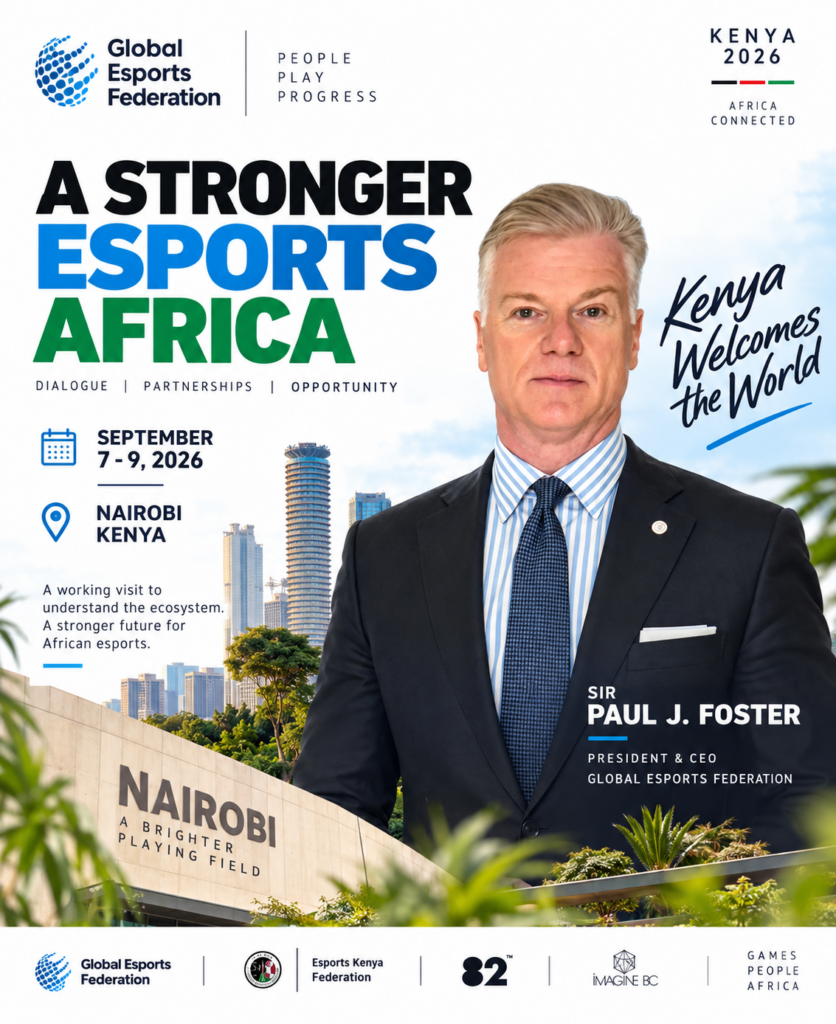
Sir Paul J. Foster, President and CEO of the Global Esports Federation (GEF), begins his first official visit to Kenya this week, September 7–9, 2026. It is also being presented as his maiden visit to Africa in this role—a significant moment for a continent that has often participated in global esports from the margins rather than from the decision-making table.
Kenya is an appropriate place to start. Its esports ecosystem combines an organised national federation, active grassroots communities, growing publisher involvement and increasingly visible international competition. Kenyan players recently competed at the FIFAe Continental Championship in Morocco, while the country has also qualified competitors across several titles for the Global Esports Games 2026 in Los Angeles.
But the importance of this visit extends well beyond Kenya.
African esports athletes have talent. What they have frequently lacked is an equally competitive operating environment. International participation can mean confronting expensive air travel, visa uncertainty, limited sponsorship, inadequate infrastructure and the considerable logistics of moving players from African cities to tournaments thousands of kilometres away. A qualification is therefore sometimes only the beginning of the battle.
This is why Foster’s itinerary matters. The programme includes government engagements, meetings with the private sector and gaming community, GEFCon Nairobi, a university address, a media roundtable and visits to grassroots esports facilities. That should provide something international decision-makers do not always obtain from conference rooms elsewhere: a view of African esports from the ground up.

The hope, however, must be that this is a working visit rather than a ceremonial one.
Africa does not simply need recognition that its esports ecosystem exists. It needs greater representation in international decision-making, more competitions hosted on the continent, credible pathways for athletes, investment in tournament infrastructure and stronger consideration of the visa and logistical barriers confronting African competitors.
The GEF itself states that its objectives include supporting national federations, athlete development, fair play, education and staging international and continental competitions. Africa should therefore be fertile ground for turning those principles into measurable programmes.
A presidential visit will not transform African esports in three days. But it can change the conversation.
The real measure of September 2026 will come afterwards: What partnerships were created? What opportunities reached athletes? What international events came to Africa? And did African voices gain greater influence over decisions affecting them?
Kenya has opened the door.
Africa should make sure the conversation continues long after the delegation leaves Nairobi.