


For more than a decade, one of the most persistent criticisms of African esports has been the continent’s dependence on platforms, publishers and tournament infrastructure developed elsewhere. Tournament registration, player rankings, competition management and analytics have largely been controlled by organisations outside Africa, leaving African tournament organisers to adapt products designed for different markets.


That picture is beginning to change.
Across the continent, a new generation of African entrepreneurs and esports organisations are quietly developing the digital infrastructure that will underpin the next phase of African competitive gaming. Tournament platforms are no longer simply organising weekend competitions. They are building player databases, rankings, educational programmes, school leagues, broadcast ecosystems and commercial products designed specifically for African audiences.
The significance extends well beyond esports. Digital competition platforms represent intellectual property, data ownership and recurring revenue. They become the operating systems of an industry.
The message is becoming increasingly clear: Africans are beginning to take control of their own esports destiny.
Africa’s Emerging Tournament Infrastructure
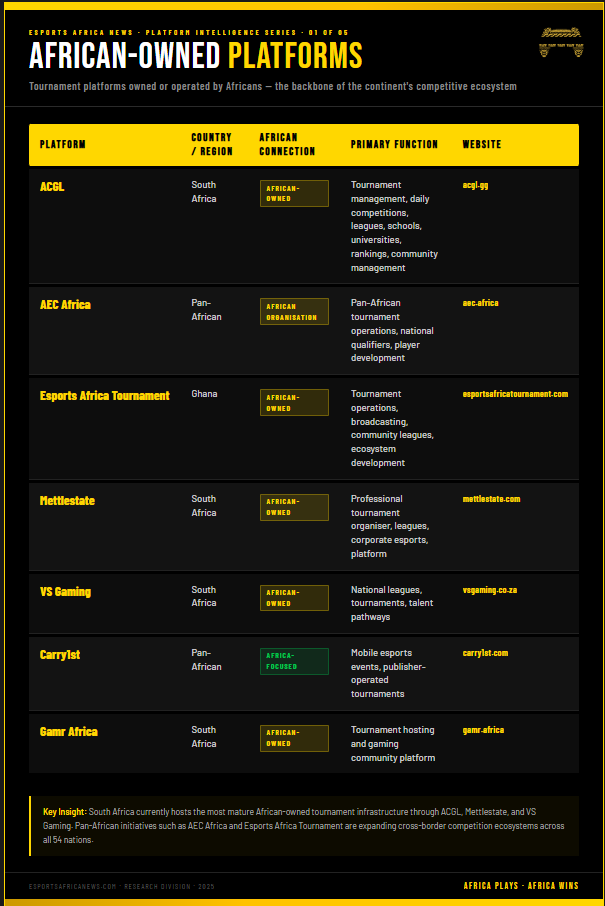
The continent now boasts several organisations operating tournament ecosystems rather than isolated events.
| Platform | Region | Primary Role | Website |
| ACGL (African Cyber Gaming League) | South Africa | Tournament management, leagues, rankings, education | https://acgl.gg |
| Giiks Game City | Ghana | Tournament management, leagues, rankings, education | https://ggcgh.com |
| GameEvo | Nigeria | Tournament management, leagues, rankings, education | https://gameevotech.com |
| VS Gaming | South Africa | National competitive gaming platform and leagues | https://vsgaming.co.za |
| AEC Africa | Pan-African | Continental esports competitions and development | https://aec.africa |
| Kon10dr | Pan-African | Tournament discovery, leaderboards and community platform | https://kon10dr.gg |
| Carry1st | Pan-African | Publisher-operated esports and mobile gaming competitions | https://carry1st.com |
| Esports Africa Tournament | Ghana | Pan-African tournament operations and media ecosystem | https://esportsafricatournament.com |
South Africa currently leads the continent in tournament technology and operational maturity. Organisations such as ACGL have evolved from hosting local competitions into managing sophisticated digital ecosystems complete with rankings, seasonal competition structures, schools programmes and community engagement tools. The organisation now positions itself as a leading platform for African esports, illustrating how locally developed infrastructure can serve regional needs.
Similarly, VS Gaming has established itself as South Africa’s premier competitive gaming platform, demonstrating how telecommunications companies and esports operators can collaborate to create sustainable national ecosystems.
Meanwhile, organisations including AEC Africa and Kon10dr are pursuing continental ambitions, seeking to connect players across national borders while creating distinctly African digital experiences.
The Global Platforms Still Powering Africa
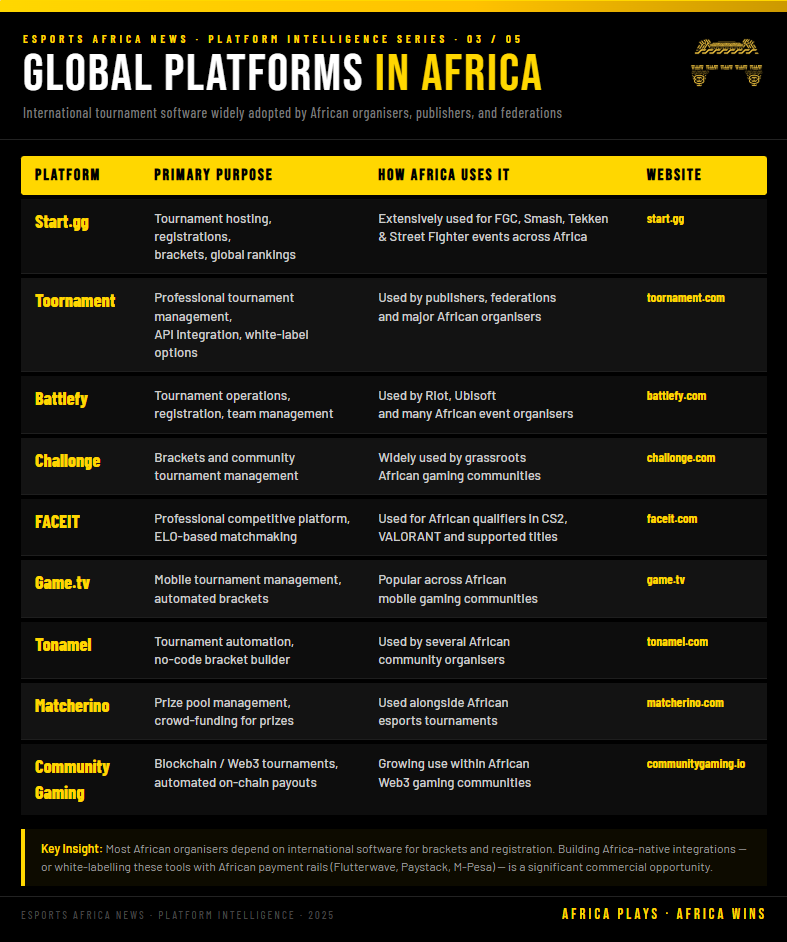
Despite this progress, much of African esports continues to rely on international tournament software.
| Platform | Function |
| Start.gg | Tournament registration and brackets |
| Toornament | Tournament administration |
| Battlefy | League and event management |
| Challonge | Brackets and grassroots tournaments |
| FACEIT | Competitive matchmaking |
| Game.tv | Mobile esports tournaments |
| Tonamel | Tournament automation |
| Community Gaming | Tournament payments and Web3 competitions |
These platforms have played an important role in helping African organisers launch competitions with limited technical resources. Yet dependence on foreign infrastructure also means that valuable player data, commercial insights and platform revenues frequently leave the continent.
The long-term opportunity lies not in replacing every international platform, but in developing African solutions capable of serving African communities while integrating with global esports.

Why Infrastructure Matters
Esports is often viewed through the lens of prize pools and professional players. The larger economic opportunity lies elsewhere.
Every tournament generates registration data. Every player creates engagement metrics. Every organiser produces commercial inventory for sponsors. Every community contributes behavioural insights that become increasingly valuable over time.
Platforms that manage these interactions own far more than tournament brackets; they own the digital infrastructure upon which entire ecosystems are built.
This explains why technology companies around the world invest heavily in tournament management software. The platform often becomes more valuable than the competition itself.
Africa is now beginning to recognise this reality.
Collaboration, Not Competition
The continent does not need dozens of disconnected tournament platforms competing for the same communities.
Instead, Africa requires interoperability.
Tournament organisers should be able to share player rankings.
National federations should access standardised competition data.
Publishers should identify verified organisers.
Media organisations should receive reliable tournament calendars.
Sponsors should evaluate measurable audience metrics across multiple events.
Educational institutions should connect directly with recognised competitive pathways.
No single organisation can build this alone.
The future belongs to collaboration between tournament operators, publishers, national federations, educational institutions, broadcasters and technology companies.
The Opportunity Ahead
African esports remains one of the world’s youngest digital industries.
That should be viewed as an advantage rather than a weakness.
Without decades of legacy systems, the continent has an opportunity to build modern, mobile-first, AI-enabled tournament ecosystems designed specifically for African realities.
Imagine a future where every African player has a verified digital esports identity.
Every tournament contributes towards continental rankings.
Every organiser follows recognised operational standards.
Every sponsor can measure return on investment through transparent data.
Every talented player can be discovered regardless of geography.
That future is achievable.
The building blocks already exist.
Esports Africa News View
For years, Africa imported much of the infrastructure that powered its esports competitions. Today, African organisations are beginning to build those foundations themselves.
This is not simply about hosting tournaments. It is about owning platforms, protecting data, creating intellectual property and ensuring that the economic value generated by African esports increasingly remains within Africa.
The continent has demonstrated that it possesses the creativity, technical expertise and entrepreneurial ambition required to develop world-class tournament ecosystems.
The next chapter will depend less on who builds the biggest platform and more on how effectively those platforms work together.
Africa does not need fifty disconnected ecosystems.
It needs one connected digital esports economy.
That is how African esports moves from participation to leadership.