

A new form of digital labour is emerging in Madagascar. Chinese entrepreneurs are employing local young people to play Delta Force, not primarily for entertainment, but to complete repetitive in-game tasks for paying Chinese customers.

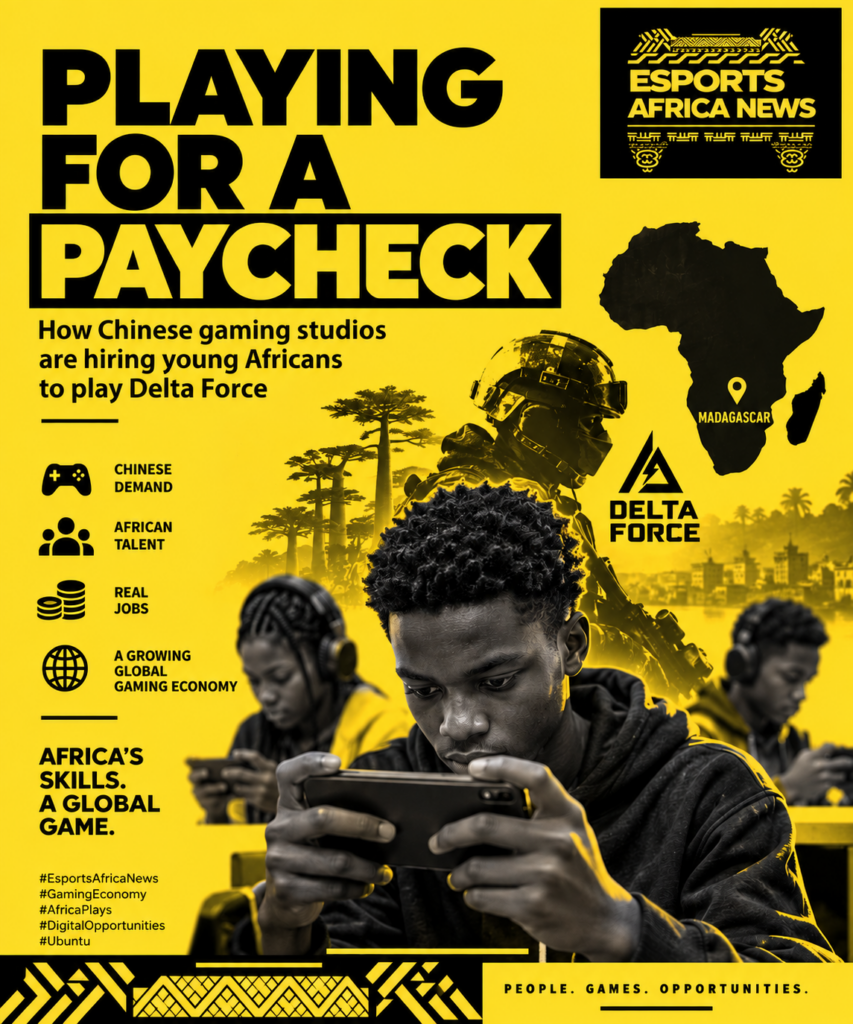
An investigation published by Singapore’s Lianhe Zaobao on 19 July 2026 documented a gaming studio in Madagascar where more than ten young men and women were playing the Chinese-developed shooter on mobile phones. Their job was to gather resources and accumulate in-game currency on behalf of Chinese players who paid to avoid repetitive gameplay. The workers were reported to earn about 500,000 Malagasy ariary per month, with additional bonuses for obtaining rare items.
The practice is commonly described in Chinese gaming culture as “代练” or “搬砖” — broadly meaning boosting, grinding or repeatedly carrying out in-game activities for economic gain. The Lianhe Zaobao report describes workers entering virtual battlefields, collecting resources and building up “Haavk Coins” for customers.
This was not the first report of the model in Madagascar. In June 2026, Chinese gaming publication Game Teahouse documented a Chinese-run Delta Force operation in the country. Its report described a studio employing dozens of workers across separate shifts. It also recorded a labour dispute in which roughly 50 to 60 workers demanded a 20% wage increase; according to the studio operator quoted in the report, about half eventually left.
Other Chinese reporting suggests that some operations have become substantially larger. TMTPost reported in May 2026 on a Chinese entrepreneur running a Delta Force operation in Madagascar that had employed as many as 500 people. The workers used mainly mobile phones to perform repetitive in-game tasks.
The phenomenon therefore represents genuine gaming-related employment, but it should not be confused with professional esports. These workers are not competing in recognised tournaments or organised leagues. They are performing paid digital labour linked to a commercial market for account progression, resources and gaming services.
There is also a significant regulatory problem. Delta Force’s official End User Licence Agreement prohibits users from sharing accounts with others and specifically bans playing on another person’s account to boost its status, level or rank. Garena’s official Delta Force enforcement policy separately identifies real-money trading involving farmed accounts, items or services as prohibited activity, with penalties including account bans, leaderboard bans and rollback of resources and progress.
Madagascar is therefore becoming an unusual case study in the global gaming economy: African labour is being organised to serve overseas gaming demand. The jobs are real and the businesses are documented, but their long-term sustainability is uncertain because key elements of the business model can conflict with the game’s official rules.
For Africa’s wider gaming industry, the story demonstrates something important: gaming is already creating forms of digital employment beyond tournaments, streaming and game development. The challenge is ensuring that future opportunities are legitimate, sustainable and capable of building skills and value within African economies.