CADE ESPORTS IS BUILDING WHAT AFRICAN ESPORTS NEEDS MOST: CONSISTENCY, COMPETITION AND INVESTMENT OPPORTUNITIES

From Nigeria to Ghana and across Africa, CADE Esports and its partners are demonstrating why regular tournaments, structured player development and measurable audience engagement could unlock the next phase of African esports growth.

The African esports industry does not lack talent. It lacks enough consistent opportunities for that talent to compete, develop and generate commercial value. CADE Esports and its partners are increasingly demonstrating how this can change.
Across Africa, esports continues to attract ambitious athletes, passionate communities and innovative tournament organisers. Yet one challenge remains stubbornly familiar: competitions are often irregular, commercial investment is limited, and many talented players have few opportunities to progress beyond local tournaments.
The problem is not necessarily the absence of interest. It is the absence of predictable competitive structures capable of transforming that interest into sustainable economic activity.
CADE Esports, working alongside a growing network of partners, is attempting to address precisely this challenge.
Having developed a portfolio of competitive gaming activations in Nigeria, the organisation is strengthening its reach across African markets. Its latest initiative, the Elite Super League (ESL): Road to Rivalry Series, offers another example of how structured competitions can strengthen the continent’s esports economy.
GH₵25,000 AND A BIGGER OPPORTUNITY
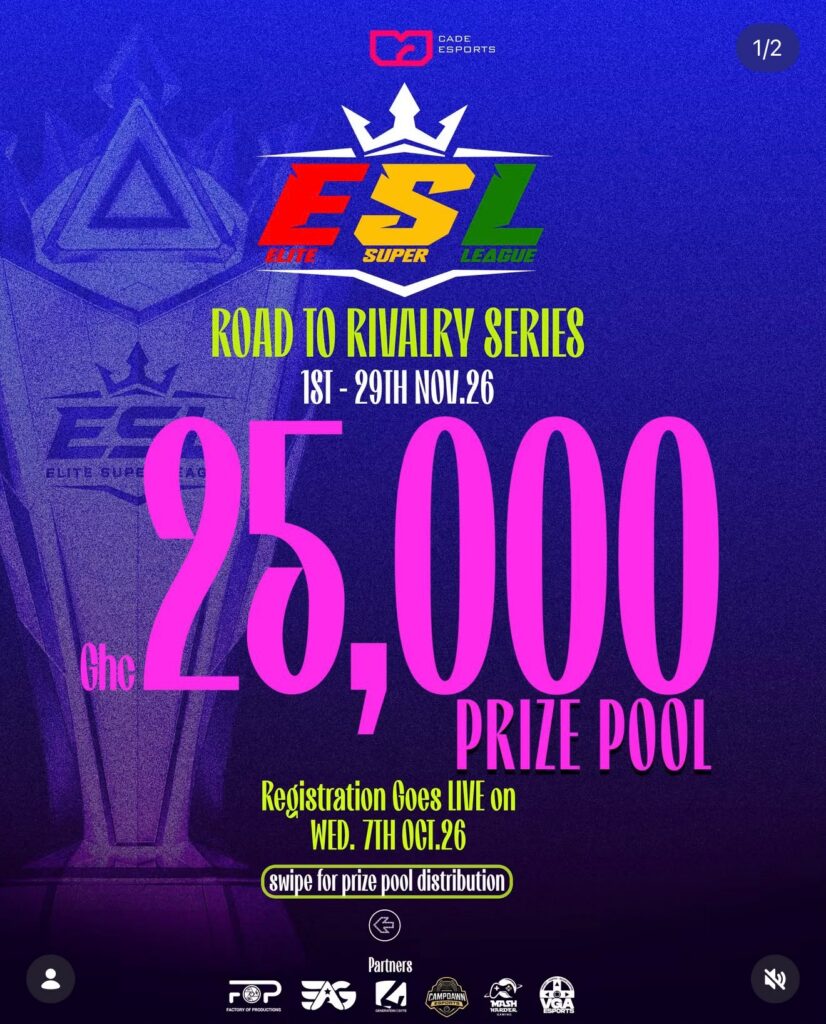
Scheduled for 1–29 November 2026, the Elite Super League will bring together 16 of Ghana’s leading EA SPORTS FC competitors, representing eight esports teams, in a month-long contest for a GH₵25,000 prize pool.
The competition is about more than prize money.
The top eight players will qualify automatically for the VGA GRID 27 Main Stage, creating a clear progression pathway between competitions.
The announced prize distribution rewards all 16 positions, with GH₵8,333 for first place, GH₵5,000 for second and GH₵3,333 for third. Even players finishing between ninth and sixteenth receive GH₵208 each.
This broader distribution matters.
Although the lower payments will not transform athletes’ finances, rewarding participation beyond the podium recognises the effort, preparation and resources required to compete. It also encourages players to remain engaged in the competitive system.
For African esports, where many athletes independently finance their equipment, internet access, transportation and training, such structures represent incremental progress.
More importantly, the qualification pathway gives athletes something that money alone cannot provide: a reason to keep competing.
FROM NIGERIAN ACTIVATIONS TO AFRICAN AMBITION
CADE Esports has not emerged overnight.
Its partnership with Game Evolution has already established a record of tournament delivery in Nigeria. In January 2026, the organisations reported having jointly delivered more than 50 esports competitions since beginning their collaboration in 2023.
Their activities have included the CADE African Gaming Expo, the National E-Soccer League and grassroots development initiatives intended to connect emerging competitors with higher-level opportunities.
The National E-Soccer League’s first season brought 16 players into a structured five-week competition, supported by live broadcasts, commentary and digital performance records.
This is important because esports development requires more than occasional flagship events.
It requires a competitive calendar that athletes can prepare for, teams can build around, broadcasters can commercialise and sponsors can confidently support.
CADE’s involvement in Nigeria’s Esports Nations Cup national-team partnership arrangements further illustrates its growing role in connecting grassroots activity with international competitive opportunities.
Its wider Rivalry Series has also involved players and organisations from Ghana, Nigeria, Senegal, Côte d’Ivoire and Kenya.
That geographic reach points towards a potentially valuable development: African esports competitions becoming interconnected rather than remaining isolated national activities.
INVESTORS NEED EVIDENCE, NOT JUST EXCITEMENT
One of African esports’ greatest commercial weaknesses is the shortage of reliable market intelligence.
Organisers frequently speak about millions of gamers, expanding digital populations and impressive growth potential. Yet investors require more precise answers.
How many people watch African esports competitions regularly? How many return for subsequent events? What is the average viewing duration? Which countries and gaming titles attract the strongest engagement? What does it cost to acquire and retain an audience?
And, crucially, how does that audience translate into commercial returns?
Without credible answers, sponsorship conversations remain dependent on enthusiasm rather than evidence.
Regular tournaments offer an opportunity to change that.
Every well-organised competition can generate valuable information: player registrations, match results, audience engagement, streaming performance, geographic participation, sponsor impressions and community retention.
Repeated over several seasons, these measurements can reveal trends that isolated tournaments cannot.
An investor is more likely to support a competition that demonstrates consistent audience growth over 12 months than one that merely promises a large audience for a single weekend.
CADE Esports and its partners therefore have an opportunity to build something commercially significant beyond tournament delivery: a dependable source of African competitive gaming intelligence.
WHY CONSISTENCY IS AN ECONOMIC ADVANTAGE
In established sporting industries, predictable competition calendars support wider commercial ecosystems.
Athletes train towards recognised seasons. Teams negotiate sponsorships around confirmed fixtures. Broadcasters plan programming. Brands develop campaigns. Fans establish viewing habits.
Esports should be no different.
A competitive calendar that runs throughout the year provides opportunities for coaches, commentators, production teams, event managers, designers, content creators and gaming venues.
It also supports talent discovery.
When competitions occur regularly, emerging athletes can demonstrate their abilities repeatedly rather than relying on a single exceptional performance.
This allows teams to evaluate consistency, resilience and development potential.
For organisers, recurring events create opportunities to reduce production costs, improve operational efficiency and develop long-term commercial relationships.
For sponsors, they provide repeated brand exposure rather than a brief appearance at an isolated event.
The commercial argument becomes stronger when these benefits can be measured and independently verified.
PARTNERSHIPS WILL DETERMINE HOW FAR AFRICA CAN GO
Perhaps the most encouraging feature of CADE’s approach is the emphasis on collaboration.
Africa’s esports industry remains fragmented, with tournament organisers, teams, community leaders and national organisations frequently working independently.
The result is duplicated effort, inconsistent standards and missed commercial opportunities.
Cross-border partnerships can help address these limitations.
Organisers can share production resources, coordinate competition calendars, establish common rules and create regional qualification pathways. National communities can retain their identities while participating in broader African competitive structures.
The emerging relationships linking Nigeria, Ghana and other African markets demonstrate what such collaboration could achieve.
However, long-term success will require transparent governance, reliable prize payments, clear commercial agreements, athlete safeguarding and consistent performance reporting.
Expansion without these foundations risks reproducing the weaknesses that have constrained earlier initiatives.
THE NEXT TEST: CAN COMPETITION BECOME A SUSTAINABLE BUSINESS?
The GH₵25,000 Elite Super League prize pool deserves recognition. But the larger test is whether the competition helps create an economic model that can be repeated and expanded.
Can athletes attract long-term sponsors? Can teams generate dependable revenue? Can broadcasts secure commercial partners? Can organisers retain audiences between events? Can reliable data demonstrate a return on investment?
These questions should sit at the centre of African esports development.
Organisations such as CADE Esports, Game Evolution, VGA Esports and their collaborating partners have an opportunity to help establish the answers through continued competitive activity.
For governments, investors and brands watching the industry, the message is increasingly clear.
African esports does not simply need more prize pools. It needs more competitions that create measurable value.
Prize money attracts attention. Regular competition develops athletes. Reliable data attracts investment. Strong partnerships build sustainable institutions.
When these elements work together, esports begins to move beyond entertainment into an organised commercial industry.
The Elite Super League represents another step along that journey.
For the 16 athletes preparing to compete in November, the immediate ambition will be victory, prize money and qualification for the VGA GRID 27 Main Stage.
For the wider African esports industry, the opportunity is considerably greater.
The future of African esports will not be determined by how many tournaments are announced, but by how many are delivered consistently, measured professionally and developed into sustainable opportunities.
CADE Esports and its partners are helping to demonstrate what that future could look like.