


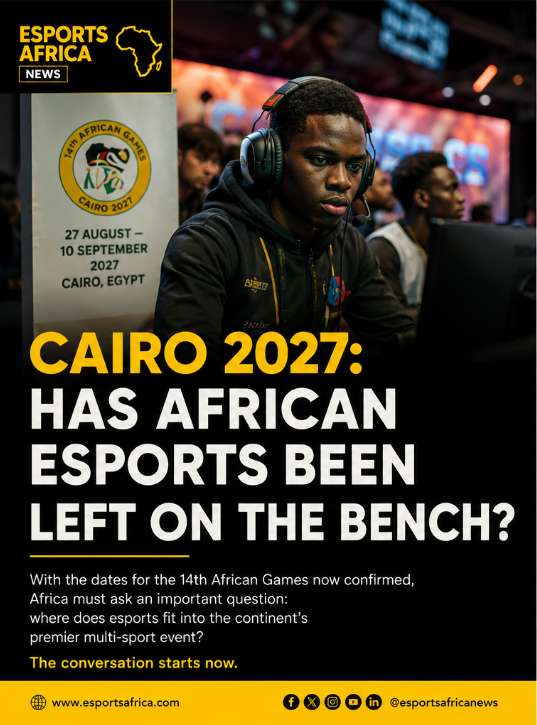
The confirmation that the 14th African Games will take place in Cairo, Egypt, from 27 August to 10 September 2027 should be celebrated across the continent. It provides African athletes with another opportunity to compete on one of the continent’s largest sporting stages while reinforcing cooperation between the African Union, national governments and sporting institutions.
Yet alongside the excitement comes an increasingly difficult question that deserves serious consideration: where does esports fit into Africa’s sporting future?

Over the past decade, esports has evolved from a niche entertainment activity into a globally recognised competitive discipline. Governments are investing in esports infrastructure. Universities are introducing esports programmes. International federations continue to debate governance structures, while major multi-sport competitions have begun embracing competitive gaming in various forms. Across Africa, national esports federations have emerged in dozens of countries, private tournament organisers continue to invest despite limited resources, and thousands of young competitors represent their nations at international championships every year.
Against this backdrop, the absence of any public discussion around esports in relation to the African Games is becoming increasingly noticeable.
This is not simply a conversation about adding another medal event. It is a discussion about recognising where African youth participation is heading. The continent possesses one of the youngest populations in the world, with mobile gaming becoming the dominant entry point into digital competition. Esports is no longer a future industry waiting to arrive in Africa; it is already creating employment for broadcasters, tournament organisers, software developers, content creators, graphic designers, coaches, analysts and event professionals across the continent.
Ignoring this ecosystem risks widening the gap between traditional sporting policy and the realities of Africa’s digital economy.
The announcement followed discussions between H.E. Ambassador Amma Twum-Amoah, Commissioner for Health, Humanitarian Affairs and Social Development of the African Union Commission, and Egypt’s Minister of Youth and Sports, H.E. Gohar Nabil. Their emphasis on collaboration, coordination and delivering a memorable African Games reflects precisely the kind of strategic leadership that could also accommodate meaningful conversations about esports.
There remains sufficient time before Cairo 2027 for stakeholders to explore possibilities. Whether through demonstration events, digital sports festivals, educational programmes, or future inclusion pathways, esports deserves to be part of the conversation rather than remaining an afterthought.
Several regions around the world are already exploring closer relationships between traditional sport and competitive gaming. Africa should not wait until other continents define the standards before determining its own position. Instead, the continent has an opportunity to develop a uniquely African model that reflects its strengths in mobile gaming, youth participation, innovation and digital entrepreneurship.
This responsibility does not rest solely with the African Union or the Cairo organising committee. National Olympic Committees, Ministries of Sport, African sports confederations, national esports federations and the private sector all have roles to play in presenting a coordinated vision. The esports community must equally demonstrate professionalism, governance and measurable social impact if it expects to be treated alongside established sporting disciplines.
Esports Africa News believes the question should no longer be whether esports is popular enough. The evidence already exists across tournaments, audiences and industry growth. The more pressing question is whether Africa is prepared to position itself at the forefront of digital sport or allow another major continental sporting event to pass without recognising one of its fastest-growing youth industries.
With Cairo 2027 now officially on the calendar, the countdown has begun. The time for conversations, collaboration and strategic planning is now—not in 2027, when the opening ceremony is already underway.