

Kwesi Hayford — The Manager Building Ghana’s National Esports Identity Before the Results Arrive

.
Before Ghana Can Win at the Esports Nations Cup, Someone Has to Unite Its Esports Communities
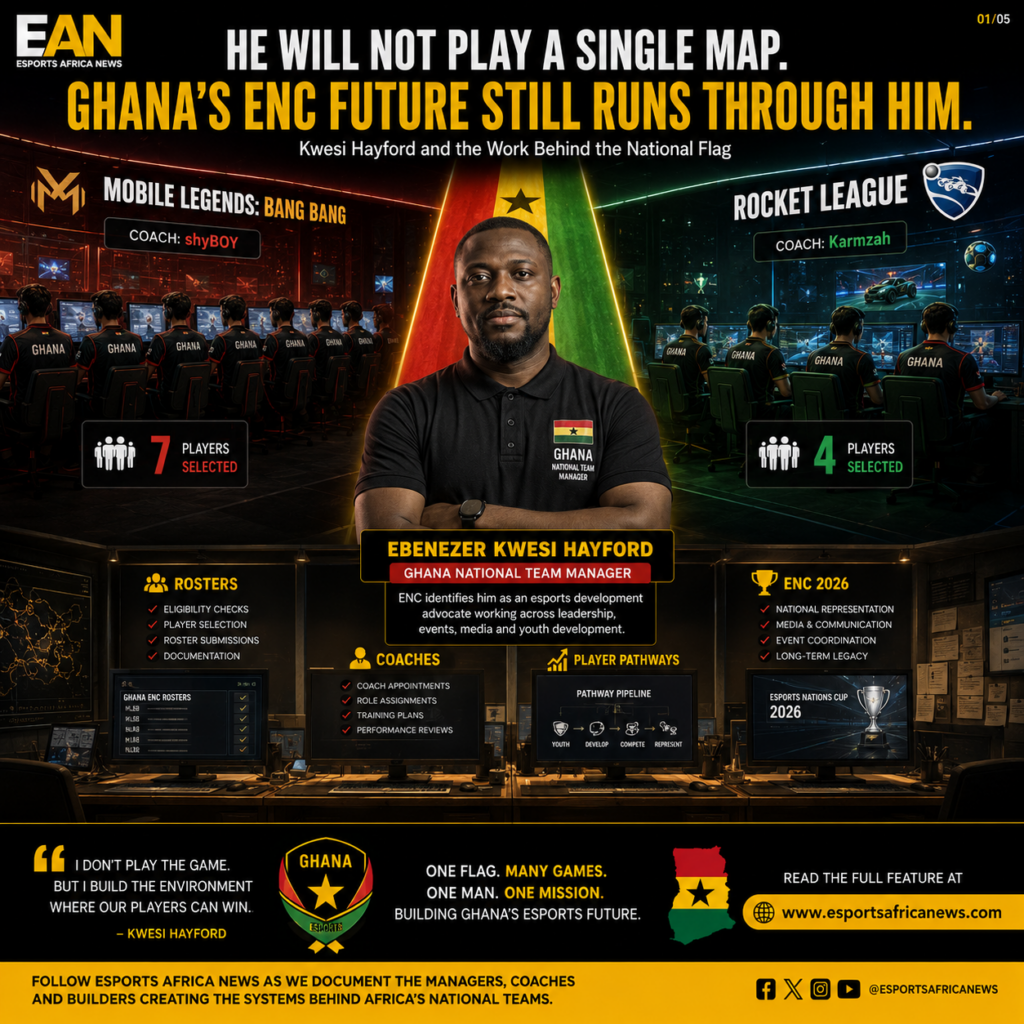
When Ghana arrives at the Esports Nations Cup, the spotlight will naturally fall on the players competing in Rocket League, Mobile Legends: Bang Bang and other game titles. Behind every roster, however, is a leader whose influence will never appear on the scoreboard. Ebenezer Kwesi Hayford, Ghana’s National Team Manager for ENC 2026, carries the responsibility of turning separate gaming communities into one national programme. Officially recognised as an esports development advocate with experience in leadership, events, media and youth development, Hayford’s role extends far beyond administration. His task is to ensure that players from different games, coaches with different philosophies and communities with different cultures all move toward a single objective representing Ghana successfully on the international stage.
That responsibility is more complex than selecting talented players. Ghana’s Mobile Legends team and Rocket League squad compete in completely different ecosystems, each requiring unique preparation, coaching methods and communication styles. A Rocket League roster trains differently from a Mobile Legends team, and their competitive calendars, strategies and communities rarely overlap. Hayford must create an environment where every squad feels equally valued while giving coaches the structure they need to prepare effectively. Good management may never appear in a match highlight, but it influences everything from player availability and logistics to communication, trust and the professionalism surrounding the national team.


Beyond tournament preparation, Hayford’s appointment reflects a broader vision for Ghanaian esports. His official profile places significant emphasis on building pathways for players, teams and young talent rather than focusing solely on immediate results. That philosophy is critical for an emerging esports nation. A successful programme cannot depend on one tournament or one generation of players. It requires clear routes from grassroots competition to national selection, stronger domestic events, better documentation of player journeys and an ecosystem where coaches, organisers and competitors continue developing long after the tournament ends. Winning matches is important, but building sustainable structures ensures future teams begin from a stronger foundation instead of starting over each year.
Ultimately, Ghana’s success at the Esports Nations Cup should not be measured only by qualification or medals. It should also be measured by whether the country leaves the tournament with a stronger national esports identity than it had before arriving. If players return home to better opportunities, if younger gamers can clearly see a pathway into national competition, and if different gaming communities feel connected under one flag, then the programme will have achieved something far greater than a single tournament result. The players will carry Ghana’s hopes inside the server, but Hayford’s work begins long before the opening match and continues long after the final whistle. Building a winning team is important; building a repeatable national esports system is what will shape Ghana’s future.
Written By Okeke Kenechukwu. A
Esports Journalist | Content Writer
Follow Esports Africa News for daily updates, tournament coverages, stories worth sharing and esports insights across Africa.