

Major cities have long competed for tourists with museums, football, food, music and architecture. A newer attraction is now entering the contest: gaming.

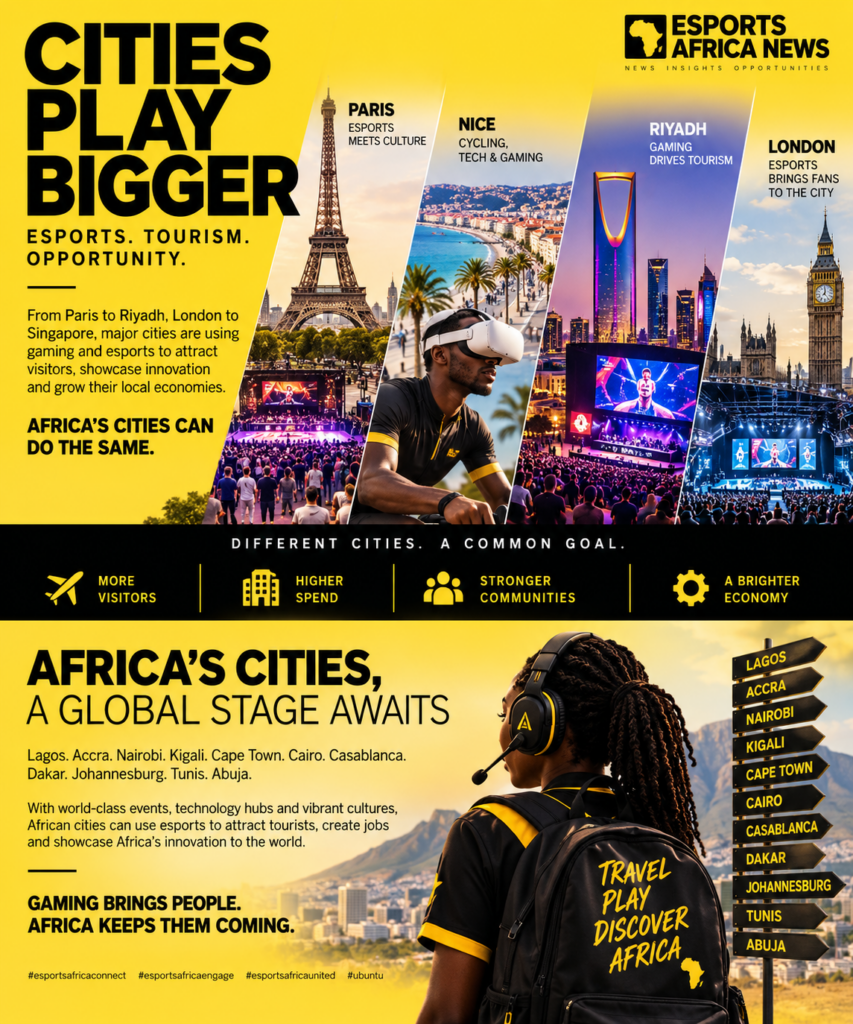
Paris offers perhaps the clearest recent example. The 2026 Esports World Cup ran for seven weeks, bringing more than 2,000 players from over 100 countries to the French capital. Its footprint extended beyond Paris Expo Porte de Versailles to the Champs-Élysées, Eiffel Tower area and other city landmarks. Organisers reported more than 2m visits across venues, fan festivals and city activations. Paris’s tourism agency has explicitly treated esports as part of the city’s visitor economy.
This is not simply tournament hosting. It is destination marketing through gaming.
The Tourist Who Travels With a Controller
Riyadh pioneered the large-scale model. The Esports World Cup helped turn competitive gaming into a summer entertainment proposition combining tournaments, festivals, culture, hospitality and international travel. Saudi reporting said tourism activity in Riyadh during the 2025 event increased by more than 29% compared with the previous year.
Singapore has similarly connected gaming with its convention economy. Gamescom Asia attracted more than 34,000 visitors in 2023, alongside 136 exhibitors and representation from 67 countries, making gaming simultaneously a consumer attraction and business-development platform.
Cologne with Gamescom, Katowice with major Counter-Strike events, Copenhagen, London, Paris, Singapore and Riyadh illustrate different versions of the same proposition. Nice adds another dimension: gaming and immersive technology can complement existing tourism products rather than replace them.
The economics are straightforward. A travelling esports fan requires flights, accommodation, food, transport and entertainment. Teams bring coaches and staff. Publishers bring production crews. Sponsors bring executives. Creators bring audiences. Developers and investors can turn a weekend tournament into a week of meetings.
Africa Should Think City, Not Simply Tournament
This opportunity is particularly interesting for African cities.
Imagine Accra Gaming Week connecting an international tournament with game-development showcases, universities, cultural tourism and visits to Cape Coast. Or Lagos Gaming Week combining esports with Africa’s enormous music, film, fashion and technology industries.
Nairobi could position esports alongside its established technology ecosystem and adventure tourism. Kigali, with its conference infrastructure, could pursue the intersection of esports, technology and business tourism. Cape Town already has competitive-gaming infrastructure: the 2026 African Gaming Championship at GrandWest featured more than eight titles.
Cairo, Casablanca, Dakar, Johannesburg, Tunis and Abuja could develop their own propositions.
The important shift is conceptual. Cities should stop viewing an esports tournament merely as players competing for prize money.
A major event can become a temporary economic district: hotels house teams, restaurants feed supporters, transport companies move visitors, universities host workshops, retailers sell merchandise, developers exhibit games and tourism authorities introduce a digitally native generation to the city.
Paris has demonstrated something important.
The arena does not have to contain the esports event. The city itself can become the arena.
For Africa’s rapidly growing cities, that may be the more interesting prize.