

Part 3: Africa Must Own Its Digital Future
The significance of Africa’s emerging games industry extends well beyond entertainment. It touches education, tourism, international trade, cultural diplomacy, technology, entrepreneurship and national identity. Increasingly, games are becoming one of the most influential ways in which countries introduce themselves to the world. For Africa, that creates an opportunity that previous generations of storytellers could scarcely have imagined.


Every successful game creates an invitation.
Players who spend thirty or forty hours exploring a fictional world inevitably become curious about the real places, cultures and histories that inspired it. This phenomenon has already been observed across other regions. Japan’s tourism industry has benefited from decades of global interest generated through games, anime and popular culture. South Korea’s entertainment sector has become an engine of economic growth, strengthening exports across industries that have little direct connection to music or film. Poland’s international reputation within technology and creative industries changed dramatically following the global success of The Witcher franchise, while the Assassin’s Creed series has repeatedly stimulated interest in historical destinations featured within its games.
Games have become modern ambassadors.
Africa should expect no different.
Imagine a generation of players discovering the trading cities of the Swahili Coast through an open-world adventure. Imagine strategy games inspired by the empires of Mali, Great Zimbabwe or Kush becoming reference points for students across Europe, Asia and the Americas. Imagine wildlife conservation games introducing younger audiences to Africa’s extraordinary biodiversity while encouraging real-world tourism and environmental awareness. These are no longer distant possibilities. The technology exists today. The creative talent increasingly exists today. What remains is the willingness to invest at scale.
This is where governments have an important role to play.
Across much of Africa, creative industries continue to occupy a secondary position within economic planning despite contributing significantly to employment, innovation and export potential. Film, music and fashion have begun receiving greater policy attention, yet game development often remains misunderstood as little more than recreation.
That perception is becoming increasingly outdated.
Modern game development is one of the most interdisciplinary industries in the global economy. It requires software engineers, artists, writers, musicians, historians, architects, economists, lawyers, marketers, cybersecurity specialists, artificial intelligence researchers, cloud infrastructure providers and business strategists. A thriving games sector stimulates demand across the wider digital economy while creating intellectual property that can generate revenue for decades.
Unlike many traditional exports, successful games are infinitely scalable. A digital title developed in Nairobi, Lagos or Accra can be purchased simultaneously in London, São Paulo, Tokyo and Los Angeles without shipping costs or complex distribution networks. Intellectual property becomes one of the few products that can reach the entire world almost instantly.
That scalability is particularly relevant for Africa’s youthful population.
The continent is home to one of the youngest populations on earth. Millions of young people are entering labour markets during a period of rapid technological transformation. While automation may replace certain traditional occupations, it is simultaneously creating demand for highly creative digital industries where originality and cultural understanding become competitive advantages.
Game development sits firmly within that future economy.
For investors, the opportunity deserves equal attention.
Investment in African games has often focused narrowly on mobile gaming or outsourcing. Those markets remain important, but they represent only part of a much larger opportunity. Original African intellectual property has the potential to generate revenues across publishing, merchandising, film adaptation, animation, esports, education and licensing. A successful game today may become a television series tomorrow, a graphic novel the following year and a global consumer brand shortly thereafter.
This intellectual property economy has transformed companies elsewhere in the world. There is no structural reason why African studios cannot achieve similar outcomes if supported with patient capital and international distribution.
Publishers also have an opportunity to rethink how they engage with African creators.
Historically, Africa has often been viewed as an emerging consumer market rather than a source of premium content. That assumption is becoming increasingly difficult to defend. Studios across the continent are producing work that demonstrates technical excellence, creative originality and commercial ambition. Rather than asking whether Africa can produce globally competitive games, publishers should increasingly ask how many opportunities they may already have overlooked.
The responsibility does not rest solely with governments or investors.
Educational institutions must continue integrating game design, animation, programming and digital art into their curricula. Technology companies should expand access to development tools, cloud services and mentorship. Telecommunications providers can strengthen digital infrastructure that enables online collaboration and distribution. Financial institutions can develop funding models suited to creative startups whose principal assets are intellectual property rather than physical equipment.
Esports organisations also have an important role within this ecosystem.
Competitive gaming and game development are often discussed separately, yet their futures are deeply connected. Every thriving games industry benefits from vibrant communities that stream, compete, create content and celebrate new releases. Esports introduces audiences to games. Streamers generate visibility. Tournament organisers build communities. Media organisations document achievements and create narratives that attract sponsors, policymakers and investors.
Together, they create an ecosystem in which games become cultural events rather than isolated products.
This is precisely why Esports Africa News believes media has a responsibility beyond reporting tournament results.
Our role is to document the evolution of an industry that is reshaping perceptions of Africa. Every independent studio launching its first title, every student building a prototype, every publisher entering the continent and every entrepreneur creating new infrastructure contributes to a broader story that deserves international attention.
That responsibility includes asking difficult questions.

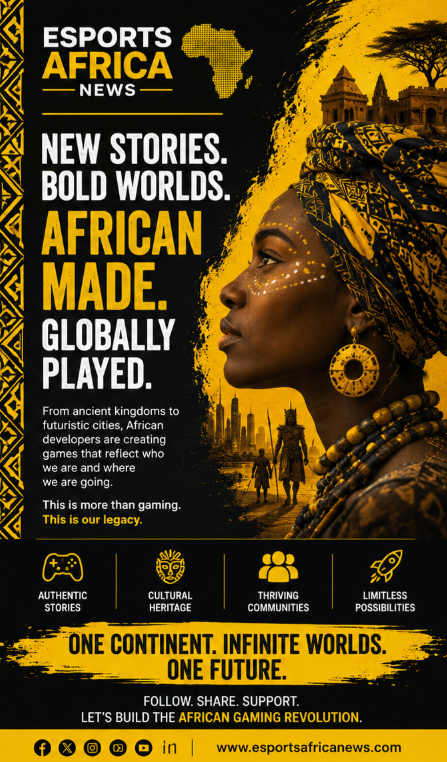
Authenticity matters.
As African-inspired games gain international attention, developers must also consider how cultures are represented. Titles such as Horn of Africa illustrate both the opportunities and the responsibilities associated with building narratives around real places and histories. Creative freedom should always be protected, but meaningful engagement with local communities, historians and cultural experts strengthens both authenticity and commercial credibility.
The objective is not to produce idealised versions of Africa.
No continent benefits from simplistic storytelling, whether overwhelmingly negative or unrealistically positive. The strongest narratives acknowledge complexity. They recognise triumph alongside challenge, innovation alongside inequality and history alongside aspiration.
Games are uniquely suited to this balance because they allow players to experience nuance rather than merely observe it.
A player navigating difficult moral choices within a well-crafted narrative gains a deeper understanding than someone consuming a headline or watching a brief news report. Interactive storytelling encourages empathy through participation.
That is perhaps gaming’s greatest cultural contribution.
It allows people to experience perspectives different from their own.
For Africa, this may become one of the defining characteristics of the coming decade. As broadband expands, digital payment systems mature and development talent grows, the continent will increasingly move from being represented by others to representing itself.
The transition has already begun.
Studios in Cameroon are building worlds inspired by African mythology. Developers in Ghana are transforming historical figures into modern superheroes. Companies in Nigeria are digitising everyday African experiences. Ethiopian creators are preserving traditional games through mobile technology. Kenyan studios are exploring history, civic education and Afro-futurism through interactive narratives. South African developers continue demonstrating that world-class technical excellence can emerge from the continent and compete internationally.
These are not isolated success stories.
They are early indicators of a structural shift.
The next decade will likely determine whether Africa becomes merely a consumer within the global games industry or one of its defining creative forces. The talent exists. The stories certainly exist. Increasingly, the technology exists as well.
The remaining question is whether governments, investors, publishers and industry leaders recognise the scale of the opportunity before them.
At Esports Africa News, we believe the answer should be unequivocal.
Africa’s games industry is no longer simply creating entertainment.
It is reclaiming narratives.
It is preserving cultures.
It is exporting ideas.
It is creating intellectual property.
Most importantly, it is allowing Africa to tell its own stories, in its own voice, to a global audience that is finally ready to listen.
The future of African gaming will not be defined solely by the number of titles released or copies sold. It will be measured by something far more enduring: whether future generations around the world come to know Africa through the creativity of its people rather than the stereotypes of its past.
That is a game worth building.