

For years, one of African esports’ biggest problems has not been a shortage of talent. It has been the absence of clearly understood pathways capable of taking a talented player from a local gaming community to national representation. Nigeria is now signalling that it wants to tackle that problem with structure.

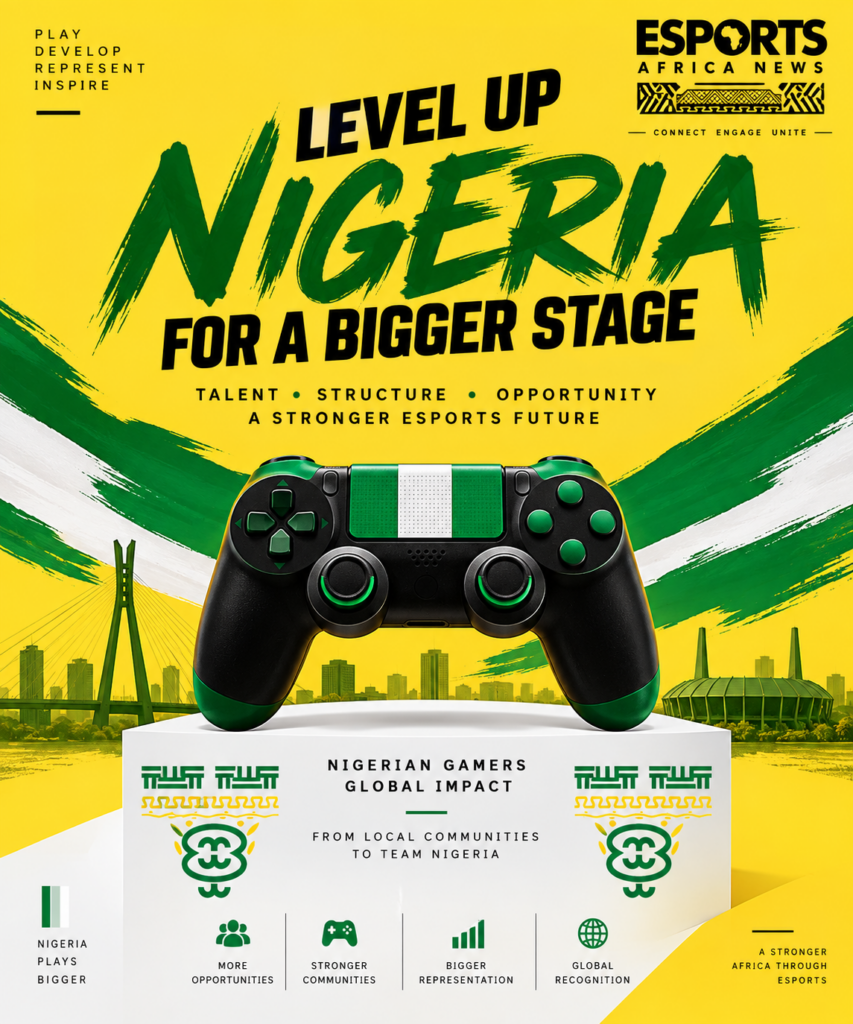
The Esports Federation of Nigeria (EFN) is increasingly presenting competitive gaming not simply as a collection of tournaments, but as an organised sporting ecosystem: eligibility, national qualifiers, scouting, roster selection, training camps and, ultimately, international representation. Its latest public campaign attempts to explain that pathway to Nigerian players—an important step in a market where the route from community competition to wearing national colours has often appeared unclear.
And the ambition goes considerably further than selecting a national team.
EFN says it operates under the oversight of Nigeria’s National Sports Commission and has outlined programmes covering a National Esports Championship, Team Nigeria, schools and universities, athlete development and training for referees, broadcasters and tournament officials. Its website also lists state associations across much of Nigeria, suggesting an effort to develop a national rather than Lagos- or Abuja-centred structure.
FROM GAMER TO TEAM NIGERIA
The pathway being communicated is relatively straightforward.
A player first needs to satisfy eligibility and registration requirements. The next stage is participation in recognised national qualifiers. Performances can then feed into scouting and roster selection, before selected athletes progress towards camps and final national-team call-ups.
That may sound routine in established sports. In African esports, however, formalising these stages matters enormously.
It begins to answer some fundamental questions: Who is eligible to represent Nigeria? Which competitions count? How are athletes selected? Who evaluates them? What happens after qualification? And how does a talented player in a local community find a route towards international competition?
This approach also aligns with the broader IESF model. IESF’s competition guidance places responsibility on national federations to conduct and document national selection processes, while participation in its World Esports Championship runs through registered players and teams affiliated with national federations.
STRUCTURE BEFORE TROPHIES
This is perhaps the more important Nigerian esports story.
Africa does not merely need more tournaments. It needs systems between the tournaments.
A sustainable ecosystem requires recognised competitions, player registration, transparent selection criteria, rankings, trained officials, coaches, safeguarding, disciplinary processes, athlete welfare, transfer rules, reliable competition calendars and pathways connecting grassroots players with national and international competition.
EFN’s stated strategy moves in that direction. The federation has publicly identified athlete development, national competitions, international representation, community engagement and professional training among its priorities. It has also promoted a FIFAe referee certification programme, illustrating that ecosystem development involves officials as well as players.
That distinction is critical.
A country can produce exceptional gamers without possessing an esports industry. An industry emerges when the player is surrounded by coaches, administrators, tournament operators, referees, broadcasters, analysts, journalists, sponsors, publishers and functioning institutions.
Nigeria appears increasingly interested in building that surrounding machinery.
THE REAL TEST STARTS NOW
There is nevertheless an important distinction between announcing a structure and proving that it works.
The next test will be implementation: how consistently qualifiers are delivered, how transparent selections become, how widely opportunities reach beyond established gaming centres, whether women and underserved communities participate meaningfully, and whether athletes can see a credible progression from grassroots competition to international representation.
That is where Nigeria’s scale could become significant.
EFN describes its mission as creating pathways from grassroots participation towards professional competition while connecting esports with education, innovation and digital skills. Its stated programmes also extend to schools and universities.
If those structures mature, the result could be bigger than Team Nigeria winning medals.
Nigeria could demonstrate something African esports urgently needs: that talent development does not begin when an international qualifier is announced. It begins years earlier with communities, regular competition, standards, records, coaching, officials and institutions.
The green-and-white jersey should therefore be the end of the pathway, not the beginning.
Nigeria has the gamers. It has the communities. It has the competitive appetite. The challenge now is to build a system capable of converting all three into sustainable sporting success.
And if Nigeria can make that system work at scale, other African markets will be watching closely.