


Success in esports is often measured by trophies, championship appearances and social media followers. Yet the organisations shaping the industry’s future are increasingly distinguished by something less visible but far more important: sustainable business models. Winning matches may capture attention, but commercial resilience determines whether an organisation survives the next decade.

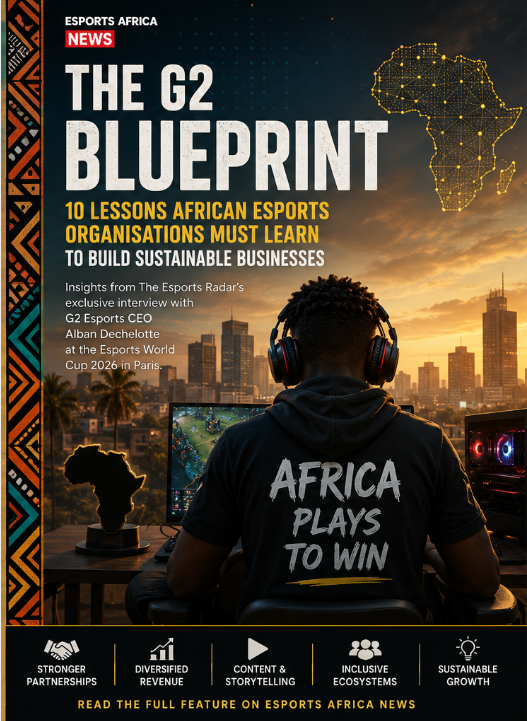
During the Esports World Cup 2026 in Paris, The Esports Radar sat down with G2 Esports Chief Executive Officer Alban Dechelotte to discuss the commercial philosophy behind one of the world’s leading esports organisations. The conversation explored how G2 has evolved from a successful competitive team into a diversified entertainment business built around commercial partnerships, intellectual property, media production and long-term strategic planning.
For Africa’s rapidly developing esports ecosystem, the interview provides more than an insight into how one global organisation operates. It offers a practical blueprint for founders, tournament organisers, clubs and publishers seeking to build businesses that can attract investment, create employment and compete on the international stage.
Africa’s esports sector has no shortage of talent. Across the continent, organisations are delivering tournaments, producing content, developing games and nurturing communities despite limited infrastructure, inconsistent investment and fragmented markets. What remains in short supply are commercially sustainable organisations capable of converting passion into profitable enterprises.
The future of African esports will depend less on producing the next world champion and more on producing the next generation of professionally managed businesses.
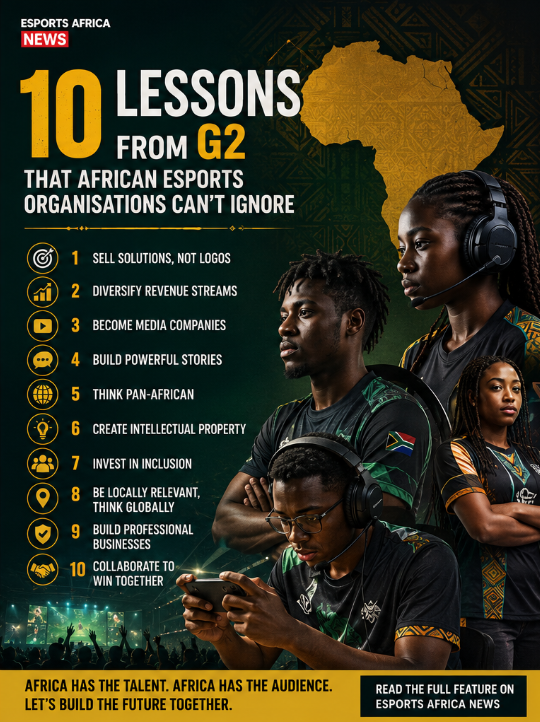
Perhaps the most striking lesson from Dechelotte’s interview is that sponsorship is no longer about logo placement. G2 reportedly approaches commercial discussions by dedicating the overwhelming majority of its proposal to marketing ideas, audience engagement and measurable business outcomes rather than simply displaying where a sponsor’s logo will appear on a jersey. As Dechelotte explained, the logo is merely the consequence of a much larger story.
This is an area where many African organisations can immediately improve. Sponsorship proposals frequently revolve around branding opportunities instead of business objectives. Companies are not investing in esports because they want visibility alone; they invest because they want to reach new customers, strengthen brand perception, launch products or increase sales. Organisations that begin every sponsorship conversation by asking how they can solve a commercial challenge rather than how much funding they need will immediately distinguish themselves from the competition.
Another defining characteristic of G2’s model is its diversified revenue structure. Rather than relying almost entirely on sponsorship, the organisation has developed several complementary sources of income, including commercial partnerships, competitive ecosystem revenues and additional business ventures.
This lesson is particularly relevant across Africa, where many esports organisations remain heavily dependent on a small number of sponsors or tournament prize pools. Sustainable organisations cannot rely on a single source of income. Coaching programmes, event production, merchandising, consulting, community memberships, educational initiatives, digital media services and intellectual property licensing all represent opportunities to build more predictable revenues. Diversification not only improves financial stability but also makes organisations more attractive to investors and strategic partners.
The interview also reinforces an increasingly important reality: modern esports organisations are media companies as much as they are competitive teams. G2 has invested heavily in storytelling, content production and entertainment, creating narratives around its players and personalities rather than relying solely on tournament results. Fans follow stories, rivalries and personalities long before they follow league tables.
Africa possesses some of the richest untold stories in global gaming. There are developers creating games inspired by African history and folklore, university students building competitive teams with limited resources, women overcoming cultural barriers to compete professionally and entrepreneurs creating entirely new esports ecosystems from scratch. These stories deserve consistent, high-quality coverage through documentaries, podcasts, interviews, short-form video and written journalism. Organisations that invest in original content are not simply marketing themselves; they are creating valuable media assets that continue generating audience engagement long after tournaments have ended.
One of the most significant strategic decisions highlighted by Dechelotte is G2’s deliberate positioning as an international organisation rather than one defined by national identity. By bringing together players from numerous countries and creating a globally recognisable brand, G2 has reduced the commercial risks often associated with regional sporting rivalries.
African esports organisations should take inspiration from this philosophy while adapting it to the continent’s unique characteristics. Too many organisations continue to think only within national borders despite operating in a continent of more than 1.5 billion people. Building relationships across West, East, North, Central and Southern Africa will create larger audiences, stronger competitions and more compelling commercial opportunities. Africa itself should be viewed as the market rather than individual countries operating in isolation.
Equally important is the recognition that intellectual property creates value far beyond tournaments. G2 has expanded into original media properties, creative services and entertainment ventures that strengthen its brand while generating additional revenue opportunities.
African esports organisations should begin thinking similarly. Every tournament brand, documentary series, educational programme, digital platform or community initiative has the potential to become intellectual property that appreciates over time. Instead of viewing events as isolated activities, organisations should consider how every project contributes to a larger ecosystem of assets capable of generating value for years rather than days.
The conversation also highlights an important commercial truth regarding diversity and inclusion. G2’s investment in initiatives supporting women in esports has not only strengthened representation but also expanded its audience and commercial appeal. Inclusion, therefore, becomes both a social responsibility and a business strategy.
Africa has millions of female gamers, creators, developers and professionals whose participation remains underrepresented across tournaments, leadership positions and broadcast talent. Organisations that actively invest in women’s competitions, leadership development, coaching pathways and content creation are not merely addressing an equality issue. They are expanding their audience, increasing sponsor appeal and unlocking markets that remain significantly underserved.
Professionalism extends well beyond competition. Many esports organisations begin as passion projects driven by enthusiastic founders, but long-term success requires robust governance. Annual business planning, financial reporting, legal agreements, sponsorship measurement, risk management and clear operational processes are increasingly becoming prerequisites for attracting investment. Sponsors and institutional partners look for organisations capable of demonstrating accountability as much as creativity.
Finally, Dechelotte’s reflections on the industry’s ongoing consolidation offer an important warning. He suggests that the future may belong to a relatively small number of globally competitive organisations, alongside specialised regional teams, leaving those caught in the middle facing increasing commercial pressure.
For Africa, this reinforces the importance of collaboration rather than fragmentation. The continent’s esports ecosystem remains young, and sustained growth will require stronger partnerships between tournament organisers, media companies, developers, educational institutions, publishers and governments. No single organisation will build African esports alone. Shared calendars, common standards, collaborative research and strategic partnerships will create a stronger ecosystem than isolated competition for limited resources.
Africa does not need to replicate G2’s model exactly. The continent’s markets, consumer behaviour and commercial realities are distinct. However, the principles underpinning G2’s success are universally applicable. Organisations that focus on delivering measurable value to partners, diversifying revenues, investing in media, creating intellectual property, embracing inclusion and strengthening governance will be significantly better positioned to attract investment and scale sustainably.
The next chapter of African esports will not be written solely by the teams that win championships. It will be written by the organisations capable of building enduring businesses that create employment, develop talent, support creators and demonstrate that esports can become a meaningful contributor to Africa’s digital economy.
The continent already possesses the creativity, entrepreneurial spirit and youthful population needed to become one of the world’s most exciting esports markets. The challenge now is to transform that potential into sustainable institutions that future generations can inherit.
Winning trophies may define a season.
Building resilient organisations will define the future of African esports.