


As the global community marks World Health Day, the esports ecosystem particularly across Africa must confront an increasingly critical question: Are we building a sustainable industry that prioritizes human health alongside competitive excellence?
Esports has evolved from a niche pastime into a high-performance domain demanding cognitive sharpness, mechanical precision, and prolonged screen engagement. Yet, beneath the growth lies a foreseeable risk including issues relating to burnout, physical strain, and mental health deterioration among players, content creators, and even developers.


This moment calls for a cautious, forward-looking approach.
The Hidden Health Costs of Competitive Gaming
Unlike traditional sports, esports often lacks structured physical conditioning, regulated schedules, and institutional health oversight. Players can spend upwards of 8–12 hours daily in static positions, leading to:
- Musculoskeletal disorders (notably in the neck, back, and wrists)
- Eye strain and digital fatigue
- Sleep disruption due to irregular gaming hours
- Elevated stress, anxiety, and performance pressure
For African esports, which is still in a developmental phase in this context, these risks are amplified by limited access to healthcare awareness, ergonomic infrastructure, and professional support systems.
The Role of Game Developers: Designing for Human Sustainability
Game developers hold significant influence over player behaviour. While engagement metrics drive revenue, there is growing responsibility to integrate health-conscious design principles:
- Built-in break reminders to counter prolonged play sessions
- Adaptive difficulty systems that reduce cognitive overload
- User interface ergonomics to minimize visual strain
- In-game analytics that encourage balanced playtime
Developers operating in or targeting African markets should also consider localised health messaging, recognising cultural attitudes toward wellness and access to resources.
Gamers and Athletes: Discipline Beyond the Screen
For players, whether amateur or professional, their health needs and concerns must be treated as performance infrastructure, not an afterthought. Sustainable excellence requires structured routines:
1. Physical Health
- Incorporate daily exercise (even light mobility and stretching routines)
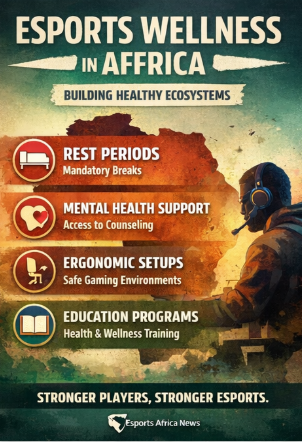
- Maintain ergonomic setups (chair support, monitor height, wrist alignment)
- Stay hydrated and adopt balanced nutrition habits
2. Mental Health
- Schedule deliberate breaks to prevent cognitive fatigue
- Engage in offline social interaction to counter isolation
- Recognize early signs of burnout and seek support where possible
3. Sleep Hygiene
- Maintain consistent sleep cycles
- Avoid late-night ranked sessions that disrupt circadian rhythms
Teams, Organizations, and Tournament Operators
African esports organisations including clubs, tournament operators, and media platforms must begin embedding health protocols into their structures:
- Mandatory rest periods during bootcamps
- Access to physiotherapy or wellness consultations (even remotely)
- Education programs on mental health and performance psychology
- Reasonable scheduling in tournaments to avoid player exhaustion
This is not merely ethical, it is strategic. Healthier players perform better, sustain longer careers, and elevate the quality of competition.


A Defining Moment for African Esports
As Africa positions itself within the global esports economy through initiatives, tournaments, and international representation, the foundation being built today will define the ecosystem’s longevity.
Ignoring health risks may yield short-term gains but will ultimately undermine talent pipelines and industry credibility.
World Health Day is not just symbolic; it is a strategic checkpoint.
The future of African esports depends not only on skill, infrastructure, and investment—but on whether its people can thrive within it.
Follow Esports Africa News for daily updates, tournament coverage, stories worth sharing and esports insights across Africa.
written by Okeke Kenechukwu (Kaseystarr)