

For more than two decades, African esports has largely been built on games developed elsewhere. From EA SPORTS FC and PUBG Mobile to League of Legends, Counter-Strike and Call of Duty, the continent has produced exceptional players, tournament organisers and passionate communities around intellectual property owned outside Africa. While this has enabled African competitors to participate in the global esports economy, it has also left the continent dependent on decisions made far beyond its borders.

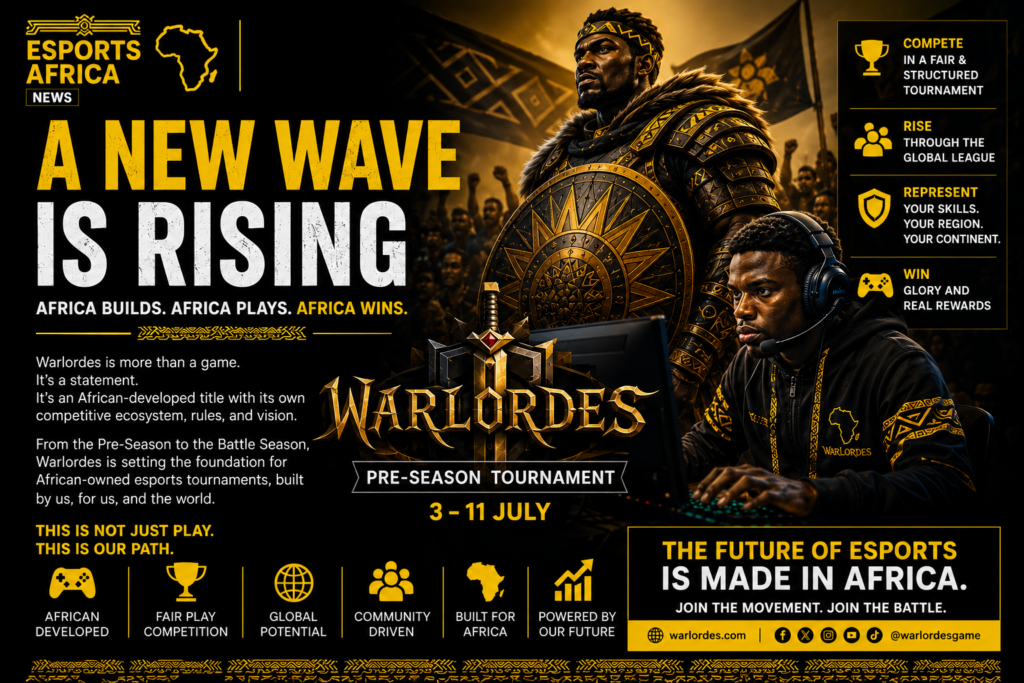
The release of the official Warlordes Pre-Season Rulebook suggests that this narrative may be beginning to change.
Beyond the game itself, what deserves attention is the competitive framework surrounding it. Warlordes is not merely launching a title; it is launching an esports ecosystem. The publication of a structured rulebook, qualification requirements, league system, automated matchmaking, knockout finals, competitive integrity provisions and prize distribution demonstrates an understanding that successful esports is built on governance as much as gameplay.
This distinction matters.
Too often, African game development has been measured by whether local studios can create entertaining games capable of attracting downloads. Yet esports requires something far more ambitious. It demands long-term competitive structures, transparent regulations, reliable tournament administration and communities willing to invest hundreds of hours mastering a single title.
The Warlordes Pre-Season appears designed with precisely this objective in mind.
Players must qualify through gameplay rather than invitation. Experience points determine eligibility. League fixtures are generated through automated matchmaking. Every participant receives an equal number of matches against unique opponents before the competition transitions into a Top 16 knockout stage. Competitive integrity is reinforced through clearly defined disciplinary measures covering cheating, account sharing, match fixing and exploit abuse.
These are the foundations of modern esports.
The significance extends well beyond one tournament scheduled between 3 and 11 July. It represents an African studio demonstrating that the continent is capable of designing competitive ecosystems rather than simply participating in those created elsewhere.
This could prove transformative for the wider African gaming industry.
African developers have increasingly demonstrated that they can create games rooted in African cultures, histories and experiences. Studios across Ghana, Nigeria, Kenya, South Africa, Côte d’Ivoire, Cameroon and several other countries are producing titles that reflect African storytelling instead of adapting imported narratives. Until recently, however, relatively few have attempted to build sustainable esports ecosystems around those games.
That gap appears to be narrowing.
Competitive gaming creates an entirely different economic model. Every successful esports title generates demand for tournament organisers, broadcasters, commentators, observers, coaches, analysts, content creators, event managers, marketing agencies, sponsors and technology providers. Each tournament extends the commercial lifespan of a game while creating employment opportunities far beyond software development alone.
In other words, esports transforms games into ecosystems.
For Africa, this distinction is critical.
The continent has repeatedly demonstrated remarkable creativity in game development while simultaneously depending on foreign intellectual property for its largest esports competitions. If African studios begin producing games designed from inception with competitive ecosystems in mind, they also begin retaining more of the economic value generated by those ecosystems.
This is precisely why initiatives such as the Warlordes Pre-Season deserve careful observation.
The competition is modest in scale compared with global esports championships, but every major esport began somewhere. League of Legends, Dota 2, Valorant and Rocket League all started with relatively small competitive communities before evolving into global industries. Their success was never determined solely by gameplay. It was built through consistent tournament structures, transparent rules, community engagement and developer commitment.
African studios now have an opportunity to follow a similar blueprint while developing ecosystems that reflect African realities.
Perhaps the greatest long-term opportunity lies in the emergence of African-owned esports circuits built around African-developed games. Rather than waiting for international publishers to allocate servers, establish regional leagues or determine qualification pathways, African developers could collaborate with tournament organisers, universities, technology companies and national esports federations to create competitions that originate on the continent.
Such an approach would strengthen local intellectual property, stimulate investment in African studios and reduce dependence on external publishing strategies.
This does not imply abandoning established international titles. Global esports will continue to play an essential role in developing African athletes and connecting the continent to international competition. Instead, it suggests that African esports should evolve into a dual ecosystem—one that continues competing globally while simultaneously investing in homegrown intellectual property capable of becoming the next generation of competitive titles.
The timing could hardly be more significant.
As governments increasingly recognise gaming as part of the digital economy and discussions continue around the future of esports within continental sporting frameworks, African-developed competitive games provide policymakers with a compelling case for investment. Supporting indigenous esports titles is no longer merely cultural policy; it is industrial policy, digital innovation policy and economic development policy.
The publication of the Warlordes Pre-Season Rulebook may therefore represent something much larger than the launch of another tournament.
It may represent the moment African developers stopped asking for a place within global esports and instead began building a competitive future of their own.
For years, Africa has produced world-class esports talent. The next chapter may see the continent produce world-class esports ecosystems powered by African intellectual property.
If that vision is realised, Warlordes may one day be remembered not simply as a game, but as one of the early milestones in the emergence of truly African esports.