

Africa’s esports boom needs a safeguarding system before the problems become bigger than the industry

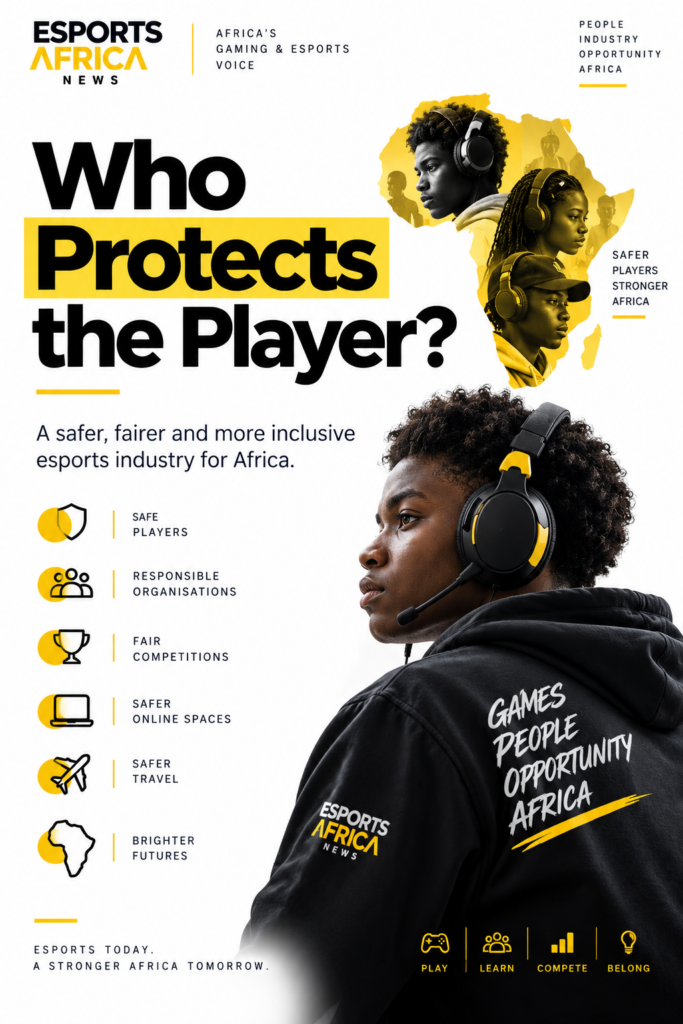
African esports is growing up. Its safeguards must do the same.
Esports Africa News has received concerning reports about conduct within gaming and esports across the continent. The issues raised range from alleged intimidation and manipulation within national organisations to unpaid tournament prizes, poorly managed competitions, online threats and harassment on social media.
Individual allegations require evidence and proper investigation. They should not be treated as established facts merely because they have been reported. Yet the pattern raises a legitimate question for an industry increasingly involving young people, money, travel and national representation: who is responsible for safeguarding the player?
The question is becoming harder to ignore.
For many African parents, gaming remains unfamiliar territory. Some respond by restricting access completely, concerned about strangers, excessive screen time, inappropriate content and online abuse. Others take the opposite approach, allowing children largely unrestricted access to games, social media, Discord communities and online competitions.
Neither approach addresses the underlying problem.
A talented 15-year-old can move surprisingly quickly from playing at home to joining a team, entering tournaments and communicating with adult coaches, administrators, tournament organisers and sponsors. Success may bring prize money, livestream appearances, contracts and travel to another city or country.
At that point, this is no longer merely a conversation about gaming. It is a safeguarding issue.
From the bedroom to the airport
Traditional sport has spent decades developing systems around young athletes. Coaches are vetted. Parents provide consent. Travel arrangements have defined responsibilities. Major organisations have safeguarding officers and reporting procedures.
African esports needs to develop comparable standards suited to a digital industry.
The risks are not confined to physical spaces. A player can be bullied in a Discord server, threatened through WhatsApp, harassed on social media or pressured through private messages without ever meeting the perpetrator.
Nor should safeguarding end at 18.
Adult players can also face coercion, harassment, financial exploitation, discrimination, threats and abuse of authority. An athlete who questions an unpaid prize, selection decision or disciplinary process should not fear exclusion from future tournaments or national representation.
This is where safeguarding meets governance.
If the same organisation controls player selection, disciplinary action, national representation and complaints against its own officials, conflicts of interest become almost unavoidable. Good governance therefore requires independent mechanisms through which players can raise concerns without fearing retaliation.

Responsibility cannot belong to one group
Parents certainly have responsibilities, particularly where minors are concerned. But expecting parents to police an entire digital ecosystem is unrealistic.
Tournament organisers have responsibilities. Teams and academies have responsibilities. National associations and federations have responsibilities. Publishers and platforms have responsibilities. Governments have responsibilities. Sponsors also have leverage: few brands would knowingly want their money associated with competitions where participants are inadequately protected.
The principle should be straightforward: safeguarding must follow the player from screen to server, server to tournament, tournament to team, and team to international competition.
Africa does not need to invent everything from scratch. International sport already offers useful safeguarding models, while organisations including UNICEF have developed substantial guidance on protecting children online. The task is to adapt good practice to African gaming rather than importing systems that do not reflect local realities.
What should change?
The first requirement is surprisingly basic: every recognised national esports organisation, academy, team or tournament operator working with young people should have a published safeguarding policy.
That policy should define unacceptable behaviour, explain how concerns can be reported and identify who is responsible for dealing with them.
Major organisations and tournaments should appoint trained safeguarding officers. More importantly, complaints involving senior officials should not be investigated solely by colleagues within the same leadership structure. An independent reporting and appeals mechanism is essential.
Tournament governance also deserves attention. Organisers should publish prize pools, eligibility requirements, competition rules and payment dates before players enter. Where substantial prize money is advertised, escrow or another form of ring-fencing should be considered. Winning a tournament should not be followed by months of chasing the organiser for payment.
Players themselves need clearer rights.
African esports could develop a simple Player Bill of Rights covering safety, discrimination, harassment, privacy, image rights, prize payments, disciplinary procedures, complaints and appeals. Rules written only for lawyers and administrators are of little use to a 16-year-old competitor.
Competitions involving minors require additional safeguards. These should include parental consent, emergency contacts, appropriate adult supervision and clear protocols covering accommodation and travel. Communication between adults and minors should also follow defined standards, particularly in private digital channels.
International travel creates another layer of responsibility. Who supervises the young player at the airport? Who is responsible at the hotel? What happens in an emergency? Who holds parental consent and medical information?
These questions should be answered before departure, not after something goes wrong.
Parents need education, not panic
Parents must also become part of the esports conversation.
A practical African esports parent guide could explain competitive gaming, Discord, livestreaming, online payments, private messaging, contracts, tournament structures, parental controls and the warning signs of inappropriate behaviour.
The objective should not be to persuade every parent that gaming is wonderful. Nor should it frighten them into banning it.
The objective is informed consent.
Parents understand football academies because generations have grown up around football. Esports is newer. The industry therefore has an obligation to explain itself.
An African standard
The longer-term opportunity is to establish an African Gaming and Esports Safeguarding Standard.
It could provide minimum requirements for national organisations, tournament operators, teams and academies covering child protection, online conduct, tournament integrity, travel, financial transparency, reporting, investigations and appeals.
Compliance should eventually matter. Government recognition, publisher partnerships, sponsorship and access to major competitions could be linked to minimum governance and safeguarding requirements.
That would turn safeguarding from a document sitting on a website into something with consequences.
African esports is becoming more ambitious. Prize pools are growing. International qualification matters more. Players are travelling. Brands and investors are watching. What was once informal competition between friends is gradually becoming an industry.
Governance must mature at the same speed.
The question, therefore, is not whether African esports needs safeguarding. It is whether the industry chooses to build credible safeguards now or waits until a serious failure forces it to.
Africa is building tournaments, teams, federations, academies and international pathways.
It must now build the systems that protect the people inside them.