The Commonwealth Games Cannot Ignore the Digital Athlete Forever
As Glasgow welcomes athletes from across the Commonwealth for the 2026 Commonwealth Games, Scotland has once again become the meeting place of a remarkable international community. The Games continue to demonstrate the enduring ability of sport to transcend geography, politics and culture, bringing together competitors from 74 Commonwealth Games Associations in a celebration of excellence, friendship and shared identity. It is a reminder that, despite changing global politics, the Commonwealth remains a unique network bound not simply by history but by people.
Yet every successful sporting event should also invite an uncomfortable question: does it still reflect the people it claims to represent?

In one important respect, the answer is increasingly difficult to defend.
The Commonwealth Games remain largely a celebration of twentieth-century sport in a twenty-first-century society. While the Games have embraced greater gender equality, expanded para sport and refreshed parts of the sporting programme over recent decades, they have yet to make room for one of the defining competitive activities of today’s younger generation—esports and the broader family of digital and phygital sports.
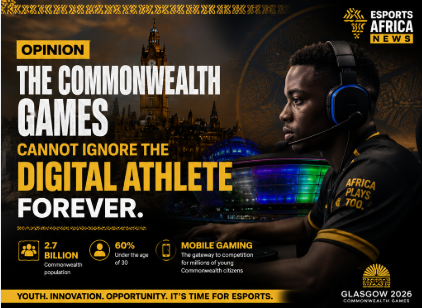
This omission matters because the Commonwealth itself is unlike almost any other international organisation. Its 56 member countries are home to around 2.7 billion people, representing more than one-third of the world’s population. More importantly, approximately 60% of Commonwealth citizens are under the age of 30. Nearly 1.6 billion young people live within Commonwealth nations, making it one of the world’s youngest international communities.
If the Commonwealth Games exist to inspire future generations, then they must increasingly reflect how those generations choose to compete.

That reality is particularly evident across Africa, South Asia and parts of the Caribbean, where digital participation has expanded far more rapidly than many traditional sports. Smartphones have become the primary gateway to entertainment, education, commerce and increasingly organised competition. For millions of young people, competitive gaming is not an alternative to sport; it is simply another way of experiencing it.
This is especially true of mobile esports.
Unlike many established Commonwealth sports that require specialist venues, expensive equipment or years of structured coaching, mobile esports lowers the barriers to entry dramatically. A smartphone, a reliable internet connection and organised competition are often sufficient to begin. This accessibility has enabled competitive gaming communities to flourish in countries where investment in traditional sporting infrastructure remains uneven.
India, now one of the world’s largest mobile gaming markets, illustrates this transformation on a remarkable scale. Similar trends are visible across Malaysia, Singapore, South Africa, Ghana, Nigeria, Kenya, Pakistan and several other Commonwealth nations where mobile-first gaming has become the dominant form of competitive play. These are not isolated markets; together they represent hundreds of millions of potential competitors and spectators.
For an organisation whose stated priorities include youth development, inclusion and opportunity, this appears less like a niche trend and more like an obvious strategic opportunity.
Critics often argue that esports lacks the physical qualities traditionally associated with sport. That debate, while understandable, increasingly overlooks how competitive performance itself is evolving. Elite esports competitors train with the discipline expected of high-performance athletes, combining technical practice with physical conditioning, nutrition, psychology and reaction training. More importantly, entirely new forms of competition are emerging that deliberately combine physical movement with digital technology.
Phygital sport is perhaps the clearest example. Combining physical performance with digital competition, phygital events are beginning to redefine what competitive sport can look like. Whether through mixed-reality competitions, connected fitness platforms or technology-enhanced racing, the distinction between physical and digital performance continues to narrow.
The Commonwealth Games could become a natural home for this evolution.
It is not as though the movement lacks precedent. During the Birmingham 2022 Commonwealth Games, the Commonwealth Esports Championships demonstrated that structured esports competition could exist alongside traditional sport. The championships attracted competitors, federations and considerable public interest. Yet four years later, that momentum has not translated into permanent inclusion within the Games programme.
This feels like a missed opportunity rather than a considered decision.
The timing is particularly significant because the Commonwealth Games themselves face important strategic questions. Rising hosting costs, increasing pressure on public finances and changing audience habits have forced organisers to reconsider how the event should evolve. Glasgow’s decision to stage a more financially sustainable edition reflects these realities. The Games must continue to demonstrate both cultural relevance and economic value if they are to thrive in future decades.
Esports cannot solve every structural challenge confronting the Commonwealth Games. It will not eliminate rising operational costs nor guarantee commercial success. What it can offer, however, is something the Games increasingly require: relevance to younger audiences whose sporting identities extend beyond the stadium.

Digital competition opens entirely new commercial possibilities. Technology companies, telecommunications providers, financial technology firms and gaming publishers represent industries that already invest heavily in esports ecosystems. Digital-first audiences consume competition differently, engaging through livestreams, social media, short-form video and creator-led communities. Integrating esports would therefore represent not simply the addition of another medal event, but the expansion of the Commonwealth Games into entirely new commercial and media ecosystems.
For Africa, the implications are even more significant.
Africa possesses the youngest population in the world, and many of its Commonwealth members are investing heavily in digital transformation. Across the continent, esports has begun creating opportunities that extend well beyond competitive players. Careers are emerging in broadcasting, journalism, software engineering, tournament operations, marketing, content production, officiating, event management and game development. These are precisely the digital professions that governments increasingly identify as central to future economic growth.
Viewing esports solely through the narrow lens of entertainment therefore misses the larger economic story. Competitive gaming has become part of the digital economy itself. It develops technical capability, entrepreneurial skills, creative industries and international collaboration. In many developing markets, it is becoming another pathway into technology careers.
This aligns remarkably well with many of the Commonwealth’s stated ambitions. The organisation regularly promotes youth empowerment, innovation, education and economic opportunity. Digital sport contributes to all four. Indeed, few initiatives possess the ability to combine international competition with digital literacy, technological innovation and youth engagement quite as effectively.
The broader sporting world has already recognised this shift. The Olympic movement has committed to dedicated esports competitions. The Asian Games have awarded medals in esports. International federations are actively exploring how digital competition should coexist with traditional sport rather than compete against it.
The Commonwealth now faces a strategic choice.

It can continue to regard esports as a parallel activity that sits outside its sporting ecosystem, or it can recognise that competitive sport itself is evolving. History suggests that the most successful sporting institutions are those willing to adapt without abandoning their values.
The Commonwealth has done this before. It modernised its programme, embraced greater inclusivity and expanded opportunities for athletes previously overlooked. Integrating esports, mobile esports and phygital competition would simply represent the next chapter in that evolution.
The purpose of the Commonwealth Games has never been merely to preserve tradition. It has always been to unite nations through competition while reflecting the aspirations of its people.
Those aspirations are increasingly digital.
The young Commonwealth citizen of today moves effortlessly between physical and virtual worlds. They learn online, build communities online, create businesses online and increasingly compete online. Expecting the Commonwealth Games to ignore that reality indefinitely is neither sustainable nor consistent with the organisation’s own ambitions.
Glasgow 2026 will rightly be remembered for outstanding athletic performances and another celebration of Commonwealth unity. Yet it should also become the moment that prompts a wider conversation about what the Commonwealth Games should look like in the decades ahead.
If the Commonwealth truly wishes to remain the Games of the next generation, it must recognise that the athletes of the future will not all begin their journey on a running track, football pitch or swimming pool.
Some will begin with a smartphone in their hands.
The challenge for the Commonwealth is no longer whether those competitors belong within its sporting family.
It is whether the Games can afford to continue leaving them behind.