Africa Has Millions of Gamers. Now It Needs to Count Them
African esports does not suffer from a shortage of enthusiasm. It suffers from a shortage of evidence. Better data could change where publishers invest, how sponsors spend and which markets emerge as the continent’s esports centres.
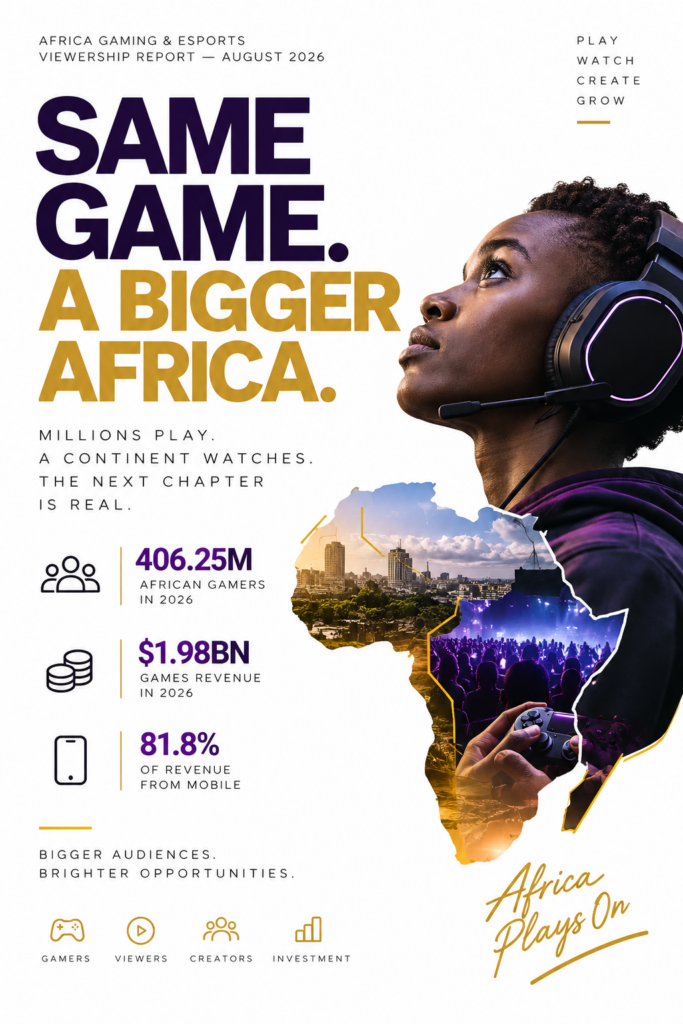
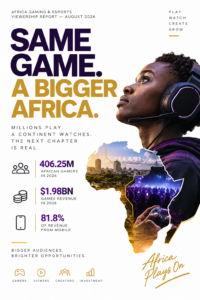
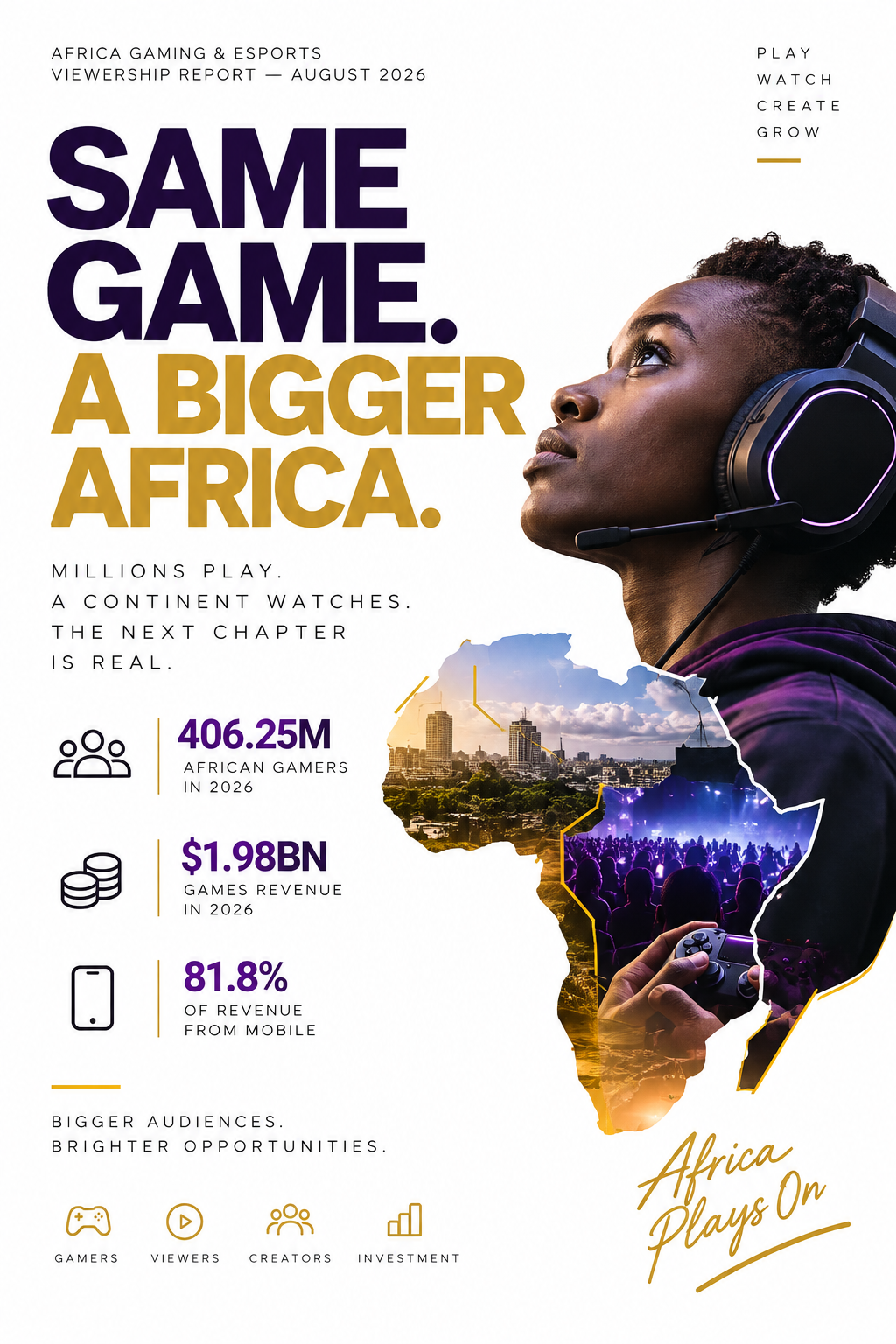
Africa has become rather good at announcing its gaming potential. The numbers certainly encourage optimism. The Africa Gaming & Esports Viewership Report — August 2026 forecasts 406.25m African gamers in 2026, generating $1.98bn in games revenue. Mobile accounts for 81.8% of that revenue.
here is, however, an awkward question: what are all these people actually watching?
The answer is less impressive. Nobody can yet say with sufficient confidence.
The report concludes that an Africa-wide estimate of gaming Hours Watched cannot reliably be established from available public data. Nor can African countries yet be credibly ranked by esports viewership. The continent may have hundreds of millions of gamers, but its attention economy remains surprisingly difficult to see.
For an industry hoping to attract serious capital, that is more than a statistical inconvenience.
It is a commercial handicap.
Money likes numbers
Sponsors rarely invest because an industry feels exciting. They invest because somebody can demonstrate an audience, identify it and, preferably, explain what it buys.
A telecoms company considering an esports partnership wants to know whether the audience consists of 50,000 occasional viewers or 500,000 highly engaged mobile gamers. A handset manufacturer wants to know which games matter. Publishers want to understand which countries justify marketing expenditure. Tournament organisers need audience figures with which to sell sponsorship.
“Gaming is growing rapidly in Africa” makes a good conference sentence. It makes a less convincing investment memorandum.
This is why measurement matters.
Consider the distinction between market size and audience size. The report’s assessed forecasts put Egypt’s games revenue at $458.1m, South Africa’s at $263m and Nigeria’s at $226.6m. Yet it correctly warns that these figures cannot be converted into a ranking of livestream audiences
A country can spend heavily on games without necessarily producing the largest esports audience. Another might have lower consumer spending but an unusually engaged competitive community.
The difference matters if you are writing cheques.
Twitch is not Africa
There is another complication. Measuring African esports as though it were merely a smaller version of Europe or North America risks measuring the wrong things extremely accurately.
The Esports World Cup offers a useful illustration. EWC 2026 generated more than 237m Hours Watched, up 29.5% year-on-year. But YouTube accounted for 42% of those hours, against Twitch’s 30.2%.
That should make anyone proposing a Twitch-heavy African measurement system uncomfortable.
Africa’s gaming audience is fragmented across platforms, countries, languages and devices. YouTube matters. TikTok matters. Creators matter. Mobile matters enormously.
Indeed, one of the report’s most important numbers may be 81.8%: mobile’s share of forecast African games revenue
Africa’s esports economy may therefore develop differently from markets where expensive gaming PCs and consoles established the competitive culture.
That is not necessarily a disadvantage. It may be Africa’s shortcut.
The smartphone is already in the arena
PUBG Mobile, Call of Duty: Mobile, Free Fire and Mobile Legends: Bang Bang are consequently more than popular games. They are potential gateways into a commercially scalable African esports market.
Kenya provides a useful example.
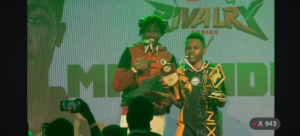
The PUBG Mobile National Championship Kenya featured 16 teams. RESCUE Esports won, followed by RUSH Esports and No Pressure, with all three qualifying for the PMGO Africa Regional Final. Infinix sponsored the competition and supplied its GT 50 Pro as the official gaming phone.
Look beyond the podium and a business model begins to appear.
A mobile audience supports a competition. The competition attracts a handset manufacturer. Creators amplify it. National competition feeds continental qualification. Players acquire a pathway and the sponsor acquires relevance.
That is considerably more useful to a commercial director than being told that Kenya has “a vibrant gaming community”.
Data turns vibrancy into inventory.
The creator is becoming the broadcaster
Traditional audience measurement also becomes less useful when the audience does not necessarily watch the official channel.
Co-streaming is changing esports distribution.
At EWC, Snax Gaming generated 5.2m Hours Watched from PUBG Mobile World Cup coverage alone. French-language EWC viewing rose 124% year-on-year while the number of French creators covering the competition increased from 122 to 200. Hindi watch time rose 300%.
The African implications are obvious.
English and French alone cannot describe the continent’s media consumption. Arabic, Portuguese and Swahili matter, alongside national and local-language communities.
The creator who explains a tournament in a familiar language may eventually be more commercially useful in a particular market than the tournament’s official international broadcast.
This changes what should be measured.
Followers are useful. Hours Watched are better. Audience geography is better still. Add engagement, language, game preference and consistency over time and something resembling commercial intelligence begins to emerge.
There is no single African esports market
Good data would also help retire one of the industry’s lazier habits: discussing “Africa” as though Cairo, Casablanca, Cape Town, Lagos and Nairobi were neighbourhoods of the same city.
They are not.
South Africa, for example, demonstrates relatively mature commercial infrastructure. The MTN SHIFT Gaming Experience combined telecom sponsorship, tournament operations by ACGL, activations across eight shopping centres and R350,000 in prize money.
Morocco offers another signal. The FIFAe Continental Championship Africa in Casablanca brought together 13 African nations. Tunisia won eFootball Mobile, Madagascar took eFootball Console and Morocco won Rocket League.
Different countries are developing different competitive advantages.
One may have strong tournament operators. Another may have creators. Another may excel in mobile esports. Another may have commercially attractive audiences. Another may become an event destination.
Without longitudinal data, these differences become anecdotes. With it, they become market intelligence.
Africa needs a gaming observatory, not another league table
The temptation will be to turn African esports data immediately into rankings: biggest country, biggest creator, biggest team, biggest game.
That would make excellent social media.
It would not necessarily make excellent research.
The more valuable objective is to establish a consistent measurement infrastructure: the same creators, platforms, games, competitions and markets tracked repeatedly over time.
The August report is appropriately candid about what remains unavailable. Africa-wide Hours Watched cannot yet be established. Country viewership rankings are unavailable. Cross-platform unique African viewers are unavailable. TikTok, Facebook, Shorts and Reels coverage remains incomplete.
That admission is important.
Credibility does not begin by pretending the gaps do not exist. It begins by measuring them.
Once a stable baseline exists, the questions become much more interesting.
Which game is gaining attention fastest in Francophone Africa? Which creators consistently move audiences? Does tournament viewership translate into player participation? Which countries punch above their economic weight? What is the sponsorship value of 100,000 African mobile-esports viewers? Which publisher is gaining momentum—and which is merely making noise?
Those are questions businesses can price.
From potential to proof
African esports has spent much of the past decade proving that it exists.
The next decade will require proving what it is worth.
Players still matter. Teams matter. Tournament organisers matter. Publishers, governments, investors and sponsors matter too. But each operates more efficiently when reliable information connects them.
The continent does not merely need more tournaments. It needs an evidence layer beneath them.
Because the uncomfortable truth about emerging industries is that potential has a limited shelf life. Eventually investors stop asking what might happen and start asking what did.
Africa already has the gamers.
Now it needs the numbers.
Download our August 2026 review here