
Africa’s Next Gaming Leaders Are Already Here—The Industry Must Give Them the Platform
The future of African esports may not be defined by the next championship. It may be defined by the next generation of leaders building the industry behind the scenes.
When discussions about esports in Africa arise, attention often gravitates towards professional players, major tournaments and prize money. These are the most visible expressions of a growing industry. Yet the foundations of any sustainable esports ecosystem are built elsewhere—by marketers, community managers, public relations professionals, content creators, business developers and digital strategists who transform games into thriving industries.
Africa’s gaming economy is entering that phase of maturity.
In an exclusive interview with Esports Africa News, Anthony “Tony” Fayez, a 21-year-old emerging professional from Egypt, offers a compelling perspective on how the continent’s next generation is redefining careers in gaming. Despite his age, Tony has already accumulated six to seven years of industry experience and now serves as a Social Media Director Intern and PR Coordinator for Egypt within an organisation dedicated to bridging sport and gaming across Africa.
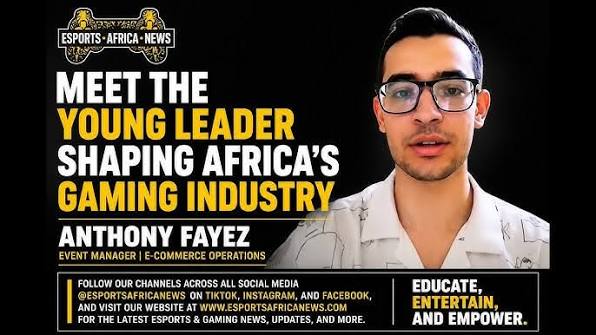
His story reflects a broader shift taking place across the continent. Increasingly, young Africans are not waiting for opportunities to appear. They are creating them.
Esports has evolved far beyond organised competition. Around every successful tournament exists an ecosystem of professionals responsible for marketing campaigns, community engagement, sponsorship activation, media relations, digital production, partnership development and brand management. These functions have become as important to the industry’s growth as the competitions themselves.
Africa’s youthful demographic gives the continent a distinctive advantage.
With the youngest population in the world and rapidly increasing internet connectivity, Africa possesses both the talent and the audience needed to build globally competitive gaming businesses. Yet realising that potential depends on more than producing elite players. It requires developing professionals capable of managing organisations, attracting investment, building communities and creating commercially sustainable brands.
Tony’s experience illustrates this transformation.
His work demonstrates that careers in gaming increasingly resemble careers across the wider digital economy. Skills in social media strategy, digital communications, public relations, content creation and audience engagement are becoming indispensable. These are transferable capabilities that extend beyond gaming into technology, media, entertainment and entrepreneurship.
This convergence is significant.
As artificial intelligence reshapes marketing, data analytics informs audience engagement and creator economies continue to expand, esports is becoming an important training ground for digital professionals. Young people entering the gaming industry today are acquiring practical experience in disciplines that employers across multiple sectors increasingly demand.
The implications extend beyond individual career development.
Africa’s gaming industry remains one of the continent’s fastest-growing creative sectors, supported by rising smartphone adoption, expanding mobile gaming markets and growing investor interest. However, long-term growth will depend upon institutional capacity. Successful ecosystems require administrators, communicators, strategists and innovators capable of building organisations that endure beyond individual events or game titles.
In many respects, the industry’s greatest opportunity lies in professionalisation.
As organisations mature, they will increasingly require specialists in corporate communications, partnership management, business development, legal affairs, finance, marketing and technology. These roles will determine how effectively African esports competes not only within the continent but on the global stage.
Young professionals are already preparing for that future.
What they require now is greater visibility, structured mentorship and meaningful opportunities to lead.
This is where industry stakeholders have an important responsibility. Publishers, tournament organisers, educational institutions, technology companies and esports organisations must invest deliberately in leadership development. Internships, mentoring programmes, certification pathways and cross-border collaborations can accelerate the emergence of a new generation of industry professionals equipped to guide African gaming through its next phase of growth.
The continent should also recognise the strategic value of youth leadership.
Young professionals often possess an intuitive understanding of digital culture, emerging platforms and online communities. Their perspectives can help organisations remain relevant within rapidly evolving consumer markets. Rather than viewing youth as future leaders, Africa’s gaming industry should increasingly recognise them as present contributors whose ideas are already shaping the ecosystem.
Anthony Fayez represents a wider movement taking place across Africa.
From Cairo to Lagos, Nairobi to Johannesburg, Accra to Tunis, a generation of young professionals is building careers not only by playing games but by creating businesses, managing communities, producing content and strengthening the digital infrastructure surrounding esports.
Their contribution deserves greater recognition.
Africa’s gaming revolution will ultimately be measured not simply by the tournaments it hosts or the champions it produces, but by the institutions it builds and the professionals it develops.
The next chapter of African esports will belong to those capable of transforming passion into sustainable industry.
By every indication, that generation has already arrived.
Watch the full interview with Anthony “Tony” Fayez on the Esports Africa News YouTube Channel:
https://youtu.be/7xJDYro1v8c?si=RNNMBX6o_Wyl1gGr
At Esports Africa News, we remain committed to highlighting the people building Africa’s gaming ecosystem—from players and developers to educators, entrepreneurs and emerging industry leaders.
If your organisation is contributing to Africa’s gaming, esports or digital innovation landscape, we would like to tell your story.
Contact: info@esportsafricanews.com
Website: www.esportsafricanews.com