Kumasi’s Digital Moment: Why Metro Digital Group and YMCA Ghana Could Build More Than a Gaming Lab
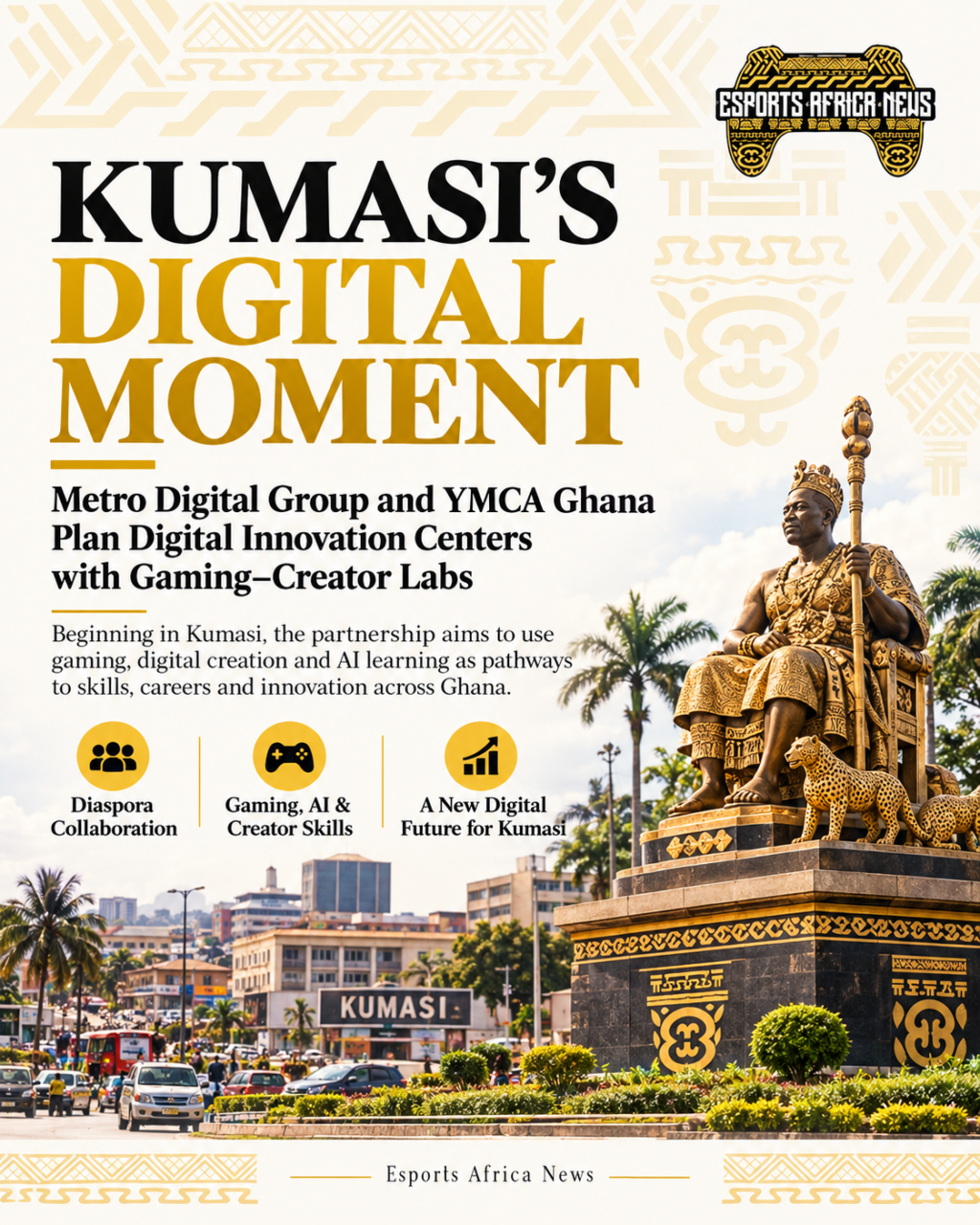
A new Ghana–diaspora partnership is betting that gaming, AI and the creator economy can become gateways into serious digital careers. More importantly, it is starting in Kumasi, a city with far more technological potential than its national profile usually suggests.
For years, Ghana’s technology story has been told mainly through Accra. Start-ups, accelerators, fintech companies, international conferences and investor delegations have clustered around the capital. Kumasi, Ghana’s second city and one of West Africa’s largest urban centres, has too often appeared in the national imagination as a commercial and cultural powerhouse rather than a technology one.
That may be beginning to change.
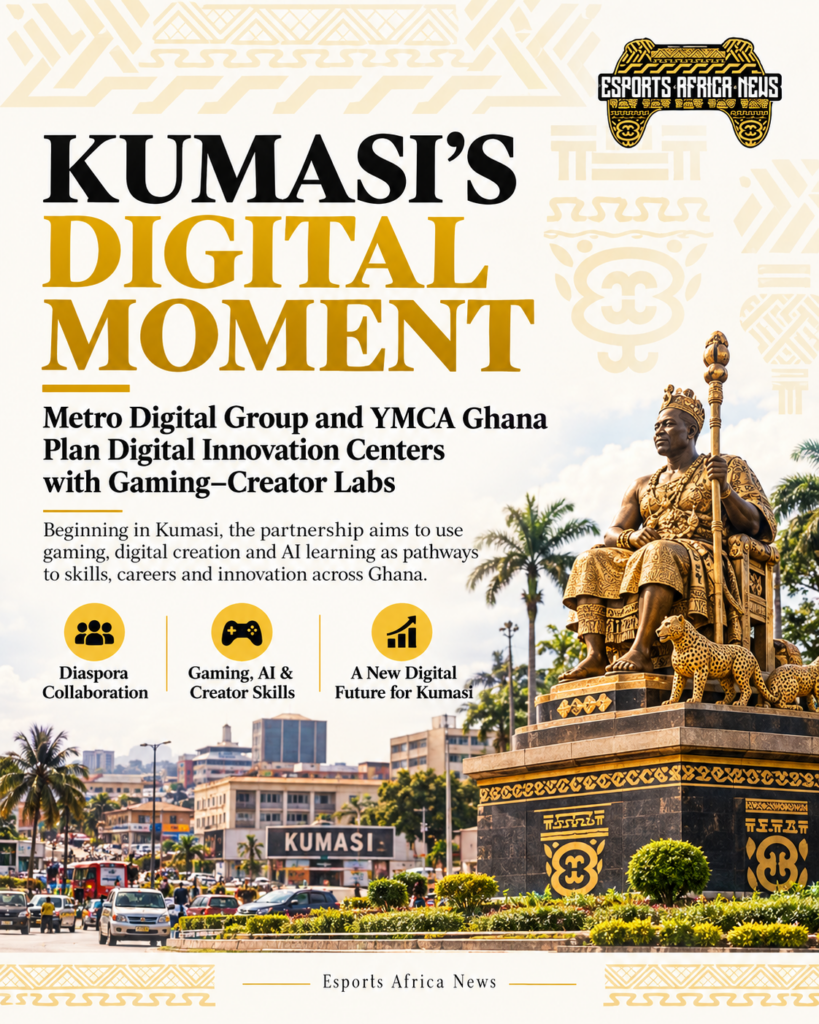
Metro Digital Group, a United States-based digital innovation and gaming organisation, has announced a strategic partnership with YMCA Ghana to develop Digital Innovation Centers across the country, beginning with an initial activation in Kumasi. The proposed centres will combine gaming, esports, content creation, music, artificial intelligence, digital-media production and workforce training.
The location matters.
Kumasi has long had much more to offer than its technology profile suggests. It has a large youth population, universities, technical institutions, a strong entrepreneurial culture and an enormous informal economy. Yet many of the investments associated with Ghana’s emerging digital economy remain concentrated elsewhere.
Starting in Kumasi therefore sends a useful signal: Ghana’s next generation of digital talent does not have to be discovered only in Accra.
Gaming as the front door
The interesting part of the Metro–YMCA model is not simply the installation of computers or gaming equipment. Africa has seen technology hubs come and go. Hardware alone rarely creates an ecosystem.
The more significant idea is to use activities young people already enjoy as the front door into skills that have commercial value.
A teenager may enter because of EA Sports FC, Call of Duty, Fortnite or another competitive title. Another may be interested in streaming, music, photography or TikTok. But behind those interests sit industries requiring graphic designers, programmers, tournament administrators, data analysts, broadcasters, video editors, cybersecurity specialists, AI practitioners, community managers, producers and digital entrepreneurs.
That is where gaming becomes more than gaming.
Metro describes its model as connecting gaming, esports, STEM, AI, creator-economy programming and technology education to workforce development. YMCA Ghana already has experience in youth development, filmmaking, media education and creative-skills programmes, giving the partnership a useful local foundation rather than requiring it to start from zero.
YMCA Ghana’s recent work provides evidence of what such pathways can produce. Its film and media programmes have helped develop young creators, while one beneficiary-turned-trainer, filmmaker Eunice Dake, recently had her film selected for the 2026 Black Star International Film Festival in Kumasi.
The organisation also won a 2026 World YMCA Impact Award for its work using filmmaking and media training to support young people into skills, livelihoods and creative careers.
Gaming could now expand that pathway considerably.
The diaspora advantage
There is another reason this partnership deserves attention.
Metro is not simply exporting an American gaming centre into Ghana. Its bigger proposition is connectivity.
The company wants participants in Ghana to interact with communities in places including Pennsylvania, Rhode Island and New York through gaming competitions, creator challenges, collaborative projects, AI learning and digital experiences.
That creates a potentially powerful role for the African diaspora.
The diaspora is normally discussed in Ghana through tourism, remittances and property investment. The digital economy offers another possibility: knowledge transfer.
An African professional in New York, London, Toronto or Philadelphia does not necessarily need to relocate to Ghana to contribute. A software engineer can mentor students remotely. A broadcaster can train aspiring commentators. A game developer can run a workshop. A technology company can sponsor equipment. A creator can collaborate with a Kumasi-based production team. An esports organisation can organise competitions connecting Ghanaian players with communities abroad.
The cost of moving knowledge across borders has collapsed.
Africa should exploit that.
Diaspora collaboration can also address one of the biggest weaknesses in African gaming and technology ecosystems: access to networks.
Talent is widely distributed. Opportunity is not.
A highly capable young creator in Kumasi may possess the same imagination as somebody in London or New York while lacking access to equipment, mentors, professional networks, publishers, investors and employers.
Digital bridges can narrow that gap.
Why Kumasi could matter
Kumasi is particularly interesting because the city already possesses many of the ingredients required for a stronger digital economy.
Its universities and tertiary institutions create a steady supply of young people. Its commercial culture encourages entrepreneurship. Its position as the economic centre of much of central Ghana gives it a large catchment area extending well beyond the city itself.
What has often been missing is visibility.
African technology development sometimes suffers from a geography problem. Investors repeatedly visit the same cities. Conferences happen in the same districts. Innovation programmes recruit from the same networks. Eventually, opportunity begins to reproduce itself geographically.
The result is not necessarily a shortage of talent elsewhere. It is a shortage of platforms capable of identifying it.
A successful Gaming–Creator Lab in Kumasi could therefore become something more important than another technology centre.
It could become an anchor.
Tournaments could attract gamers. Creator programmes could bring filmmakers and musicians. AI certification could attract students and professionals. Podcasting facilities could support media entrepreneurs. Hackathons could connect universities and companies. Digital-skills programmes could serve both young people and adults.
One building could begin creating several overlapping communities.
That is how ecosystems grow.
From playing to producing
Africa already has millions of young people consuming games, music, video and social media.
The economic question is how many can eventually earn from producing them.
This is why the language used by YMCA Ghana is important. Its stated ambition is to help young people move from being consumers of technology towards becoming creators and future leaders.
The distinction matters enormously.
Africa’s gaming opportunity will remain limited if the continent is treated mainly as a growing consumer market for products built elsewhere.
The greater prize is participation across the value chain: studios, tournament operators, creators, broadcasters, engineers, publishers, payment companies, platforms, marketers and technology businesses.
A teenager who walks into the Kumasi centre to play a game could eventually become the person designing one.
That should be the ambition.
Build the ecosystem, not just the room
There is, however, a familiar danger.
Africa does not need another impressive technology facility that attracts attention at launch and becomes quiet afterwards.
The real test will be utilisation.
The partners will need regular programming, competitions, creator projects, certification, mentorship, school engagement, university partnerships and connections to employers. Equipment will need maintaining. Internet connectivity must be reliable. Programmes must lead towards recognisable opportunities.
And companies must participate.
Telecommunications operators, banks, hardware manufacturers, game publishers, cloud providers, AI companies, universities, development institutions and Ghanaian businesses should see the project not merely as corporate social responsibility but as an opportunity to develop future customers, creators and employees.
Metro and YMCA Ghana have indicated that their model is designed to accommodate technology partners, workforce programmes, creator initiatives, branded experiences, gaming competitions and commercial partnerships.
That approach is sensible. Sustainability matters.
Kumasi deserves its turn
Accra will remain central to Ghana’s technology economy. It should not remain the only city through which that economy is viewed.
Kumasi has population, culture, commerce, universities, creativity and youth. What it needs is more infrastructure capable of converting those assets into digital opportunity.
That is why the Metro Digital Group–YMCA Ghana partnership is worth watching.
Its importance may ultimately have little to do with how many gaming PCs are installed.
The bigger question is whether a young person in Kumasi can enter because they love gaming, discover digital production, learn AI, meet collaborators in America, develop a portfolio, build a company and eventually employ somebody else.
If that happens repeatedly, the project will have achieved something far more valuable than building a gaming centre.
It will have helped build an ecosystem.
And perhaps Ghana’s next major technology story will not begin in Accra.
It will begin in Kumasi.