
From the Simulator to the Circuit: Africa Is Quietly Building Its Next Generation of Engineers
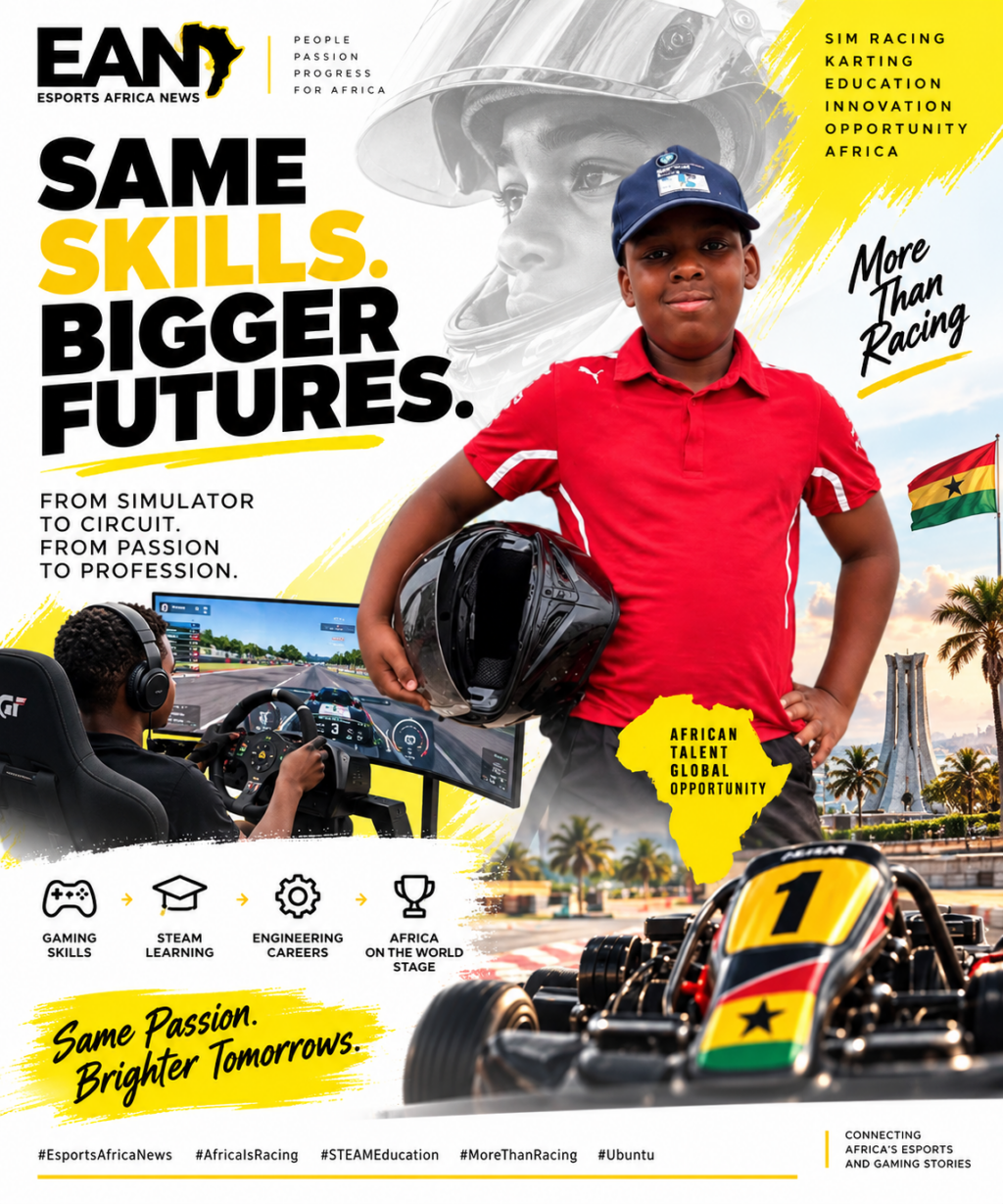
For years, gaming and motorsport have often been placed in different boxes. One is treated as digital entertainment; the other as a serious physical sport built around machines, mechanics and engineering.
Sim racing is rapidly making that distinction obsolete.
Across Africa, a potentially powerful pathway is emerging. Young people can begin with a steering wheel, pedals and racing simulator, learn the fundamentals of vehicle dynamics and racecraft in a digital environment, progress into karting, and eventually discover careers in engineering, automotive technology, data, software, broadcasting and professional motorsport.
The kart may be physical. But increasingly, the classroom starts on a screen.
The participation of young African drivers such as Ghana’s Ezra Stephens at Karting Africa in Benguela, Angola, illustrates the wider opportunity. The headline may be about racing, but underneath it sits something potentially much bigger: Africa can use sim racing and karting as gateways into STEAM education and technical careers.

The Simulator Is More Than a Game
A good racing simulator asks a young driver to think.
Where is the braking point? Why is the rear of the car losing grip? What happens when tyre temperature changes? How does altering brake balance affect corner entry? Why is one racing line faster than another?
Suddenly physics is no longer an equation written on a classroom board. It is happening at 200 kilometres per hour on a virtual circuit.
Mathematics becomes lap times, sector comparisons and telemetry. Physics becomes acceleration, friction, momentum, weight transfer and aerodynamics. Computing becomes simulation software and data analysis. Engineering becomes the process of changing a setup, testing it, measuring the outcome and trying again.
That is STEAM education in motion.
This is particularly important for Africa because access has always been one of motorsport’s biggest barriers. Traditional motorsport is expensive. Cars, engines, tyres, fuel, mechanics, transportation, circuits and safety equipment create a formidable financial wall.
Simulation does not eliminate that problem, but it can dramatically lower the cost of the first step.
A simulator can run hundreds of laps without consuming a single tyre. A young driver can practise a circuit repeatedly without transporting a kart across a country. Coaches can review performance remotely. Drivers can compete internationally without initially needing an airline ticket.
For a continent where geography, infrastructure and household income can restrict access to motorsport, that matters.
Karting Completes the Classroom
Sim racing should not be presented as a replacement for karting. The exciting opportunity is the connection between them.
Simulation allows repetition, experimentation and data-led learning. Karting introduces the physical consequences: real grip, real braking forces, mechanical preparation, track conditions, safety procedures and the pressure of competition.
Put the two together and something interesting happens.
We stop simply producing gamers and drivers. We begin producing technically curious young Africans.
A child interested in improving a lap time may start asking why changing tyre pressure affects performance. Another may become fascinated by telemetry rather than driving. Someone else may want to understand how the simulator itself works. Another could become interested in designing a steering system, coding simulation software, building a racing broadcast or analysing performance data.
The driver is only one person in a much larger ecosystem.
Behind every successful racing operation are engineers, mechanics, data analysts, designers, software developers, fabricators, coaches, content producers, event managers and commercial specialists.
That is where the African opportunity becomes much larger than motorsport.
Africa Does Not Only Need Drivers
The ambition should not simply be to discover “Africa’s next Formula One driver”.
That is exciting, but too narrow.
Africa needs its next generation of automotive engineers. It needs software developers working on mobility systems. It needs mechanical and electrical engineers, data scientists, designers, technicians and advanced manufacturers.
Sim racing can become one of the unconventional doors through which young Africans discover those professions.
Imagine an African youth motorsport programme where a 12-year-old begins on a simulator.
They learn racing lines and braking. Then telemetry is introduced. Mathematics and physics are connected to their performance. They learn basic kart maintenance. They progress to a real kart. Engineering students help analyse their data. Local universities support vehicle-development projects. Technology companies provide equipment. Motorsport organisations provide competition.
Now the racing programme has become an educational pipeline.
And crucially, not everyone needs to become the driver.
The youngster who discovers that analysing the data is more exciting than setting the fastest lap may eventually become the engineer who makes someone else faster.
That is success too.
A Laboratory Disguised as Entertainment
Africa has an enormous young population and a rapidly developing digital culture. The challenge is converting curiosity into capability.
Gaming can help.
Young Africans already understand competition, digital environments and interactive learning. Rather than fighting that behaviour, educators, governments and businesses should ask how it can be redirected towards productive skills.
Sim racing provides an unusually clear bridge.
Schools could establish modest simulation laboratories connected to physics, mathematics and computing lessons. Universities could connect motorsport programmes with mechanical engineering and computer science departments. Karting organisations could incorporate simulator training and telemetry analysis into junior development.
Esports organisations can provide the competitive infrastructure.
And private companies can support equipment, scholarships, competitions and technical training.
The result is an ecosystem in which education does not always look like education.
Sometimes it looks like a teenager desperately trying to find three-tenths of a second around a virtual circuit.
But behind those three-tenths are mathematics, physics, concentration, experimentation, problem-solving and engineering.
The Race Africa Should Want to Win
There is something fitting about young African racers preparing digitally before competing physically.
The continent has often been forced to leapfrog infrastructure gaps. Mobile technology transformed communications and financial services without waiting for every household to acquire a fixed telephone line or traditional bank branch.
Simulation could offer motorsport and technical education a smaller version of that opportunity.
Africa does not need to replicate every stage of Europe’s century-old motorsport infrastructure before it begins developing talent.
It can combine gaming, esports, simulation, karting, education and engineering into its own pathway.
That makes events such as Karting Africa more important than the chequered flag.
Every young African standing beside a kart represents a driver.
But somewhere behind that driver could also be a future race engineer, automotive designer, programmer, mechanic, data scientist or entrepreneur.
And perhaps that is the most exciting part of Africa’s emerging racing story.
The next great African engineer may not discover engineering in a textbook.
They may discover it while chasing a faster lap.
#EsportsAfricaNews #KartingAfrica #SimRacing #MotorsportAfrica #STEAMEducation #AfricanEngineering #AfricanYouth #EsportsAfrica #Ghana #Angola #AfricaIsRacing #Ubuntu