
You Still Belong Here: Mental Health, Gaming and the African Power of Ubuntu
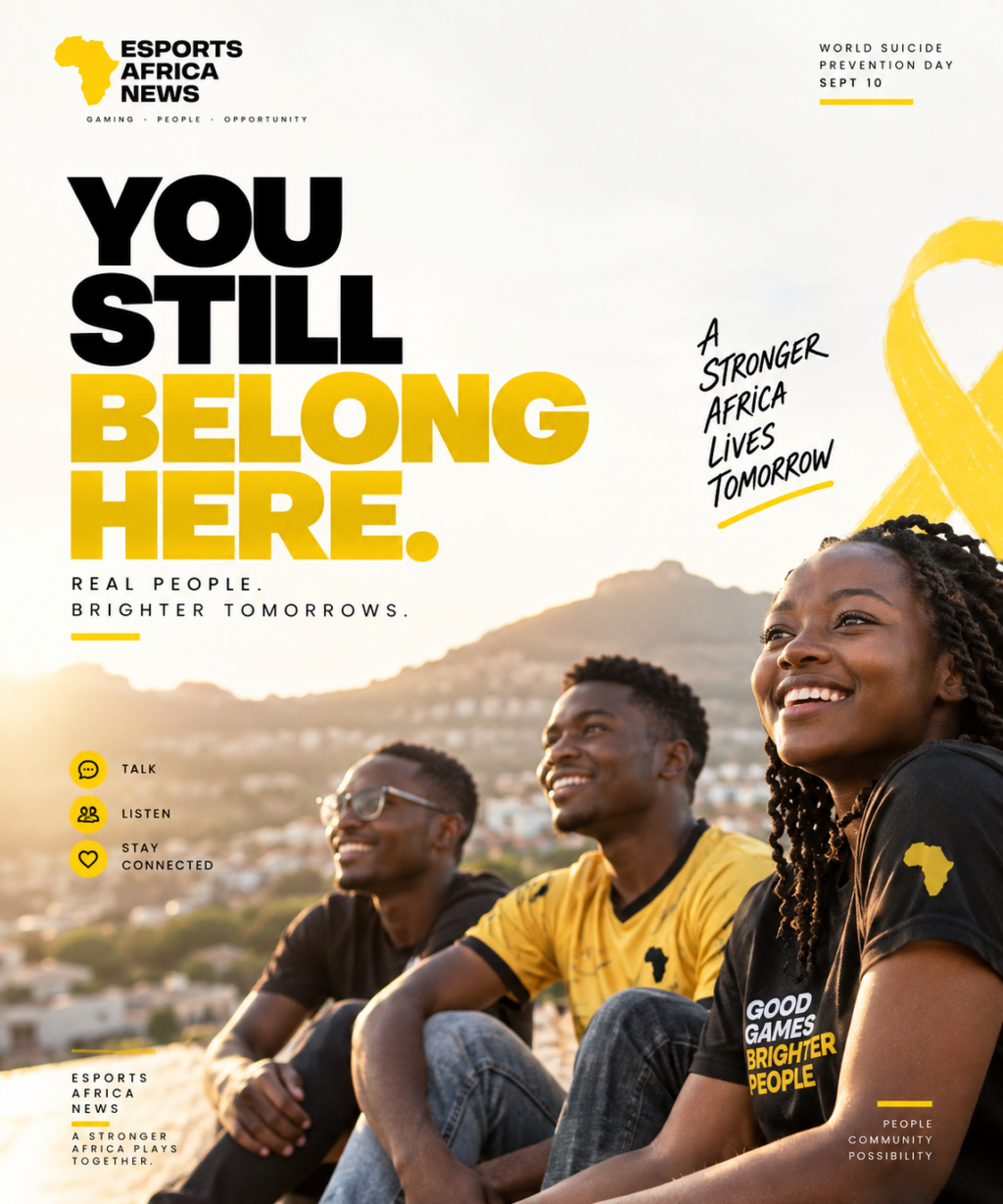
Mental health does not recognise gender, status, nationality, age or gaming rank. As gaming and esports grow across Africa, our conversations about performance, opportunity and competition must grow to include something even more fundamental: the wellbeing of the people behind the screens.

There is a person behind every username.
Behind the tournament victories, rankings, livestreams, social-media posts and carefully constructed online identities are ordinary people dealing with ordinary human pressures.
Mental health affects everyone. Men and women. Boys and girls. Professional players and casual gamers. Coaches, casters, developers, creators, tournament organisers, administrators, parents and fans.
Yet it is remarkably easy to forget this in gaming.
A player may appear confident on a livestream while struggling privately. A creator with thousands of followers may feel profoundly isolated. A tournament organiser may carry financial and professional pressures that nobody sees. A young player trying to turn talent into a career may be dealing simultaneously with expectations from family, school, teammates and the internet.
For some, gaming is an escape from those pressures. For others, it can become another place where those pressures accumulate.
The pressure behind the screen
Gaming can be enormously positive. It creates friendships, develops skills, builds communities and increasingly offers African young people pathways into competition, media, technology, game development and other careers.
But competitive gaming also has pressures that should not be romanticised.
There are rankings to maintain, tournaments to win, contracts to secure and audiences to satisfy. Players can face abuse after poor performances. Creators live with public metrics that constantly measure views, followers and engagement. Young competitors may have to reconcile training with education, employment and family responsibilities.
Then there is the internet itself.
Cyberbullying, harassment, racism, sexism, threats and public humiliation can follow someone from a tournament lobby onto Discord, WhatsApp, X, Instagram or TikTok. Unlike a difficult day at a physical workplace, online pressure can follow a person into their bedroom.
And mental-health difficulties are not defined by gender.
Men can struggle. Women can struggle. Young people can struggle. People who appear successful can struggle.
The expectation that someone should simply “be strong” can make matters worse. Strength should not mean suffering silently.
Africa already understands something important
There is, however, an important resource available to African gaming communities. It is not a new technology or another platform.
It is community.
Across a continent of extraordinarily diverse cultures, languages and traditions, there are longstanding ideas about collective responsibility, extended family, kinship, neighbourhood and belonging.
One of the best-known expressions is Ubuntu, often summarised as:
“I am because we are.”
Ubuntu reminds us that an individual does not exist entirely separately from the people around them.
The traditional African concept of the village similarly recognises that responsibility for another person’s wellbeing does not always stop at the front door of their immediate family. Extended families, friends, neighbours, elders, teachers, faith communities and other social networks have historically formed layers of support.
Modern Africa is different. Cities are larger. Families can live across countries and continents. Communities increasingly exist online.
But the principle remains remarkably relevant.
Perhaps the African gaming community needs to build a digital village.
The digital village
A gaming community should be somewhere people can compete fiercely without losing their humanity.
Ubuntu does not mean eliminating competition. Nor does it mean that communities can replace psychologists, doctors or other qualified professionals.
It means noticing people.
It means checking on the teammate who suddenly disappears from Discord.
It means asking a player whether they are genuinely okay rather than assuming that silence means everything is fine.
It means refusing to turn someone’s poor tournament performance into sustained online humiliation.
It means recognising when banter has become bullying.
And sometimes it simply means listening without immediately trying to solve everything.
A message saying, “I haven’t heard from you recently. How are you doing?” can matter enormously.
That responsibility belongs to everyone.
Families need to be part of the conversation
Parents and families also have an important role.
Gaming can sometimes create a generational divide. A parent may see excessive screen time where a young person sees friendship, competition and ambition. A gamer may believe their family simply does not understand their world.
Neither side benefits when communication disappears.
Families do not have to understand every game, tournament or esports organisation to take an interest in the person playing.
Ask what they are playing. Ask about their team. Celebrate sensible achievements. Understand who they communicate with online. Discuss sleep, education, exercise, money, online safety and healthy boundaries.
Most importantly, create an environment where someone can say, “I am struggling,” without fearing ridicule or immediate judgement.
That is Ubuntu at home.
Gaming organisations also have responsibilities
Community care cannot rest entirely on individuals and families.
Esports teams, tournament operators, gaming organisations, federations, publishers, community administrators and content platforms should increasingly regard mental health and safeguarding as part of responsible ecosystem development.
That can include clear anti-harassment policies, confidential reporting mechanisms, trained safeguarding contacts, appropriate moderation and procedures for responding when someone appears to be in distress.
Coaches and team managers should understand that player welfare and performance are connected. Tournament organisers should consider what happens to players before, during and after competitions. Organisations working with children and vulnerable people require particularly robust safeguarding systems.
The African esports industry is still being built. That presents an opportunity.
We do not have to reproduce every weakness of older sporting and entertainment industries before correcting them.
We can design wellbeing into the ecosystem from the beginning.
When community is not enough
There is also an important boundary to recognise.
Ubuntu is support. It is not a substitute for professional mental-health care.
Friends should be friends, not therapists. Parents should not feel expected to diagnose conditions. Coaches should know when an issue has moved beyond their competence.
If you are persistently struggling with your mental health, speak to a qualified healthcare or mental-health professional.
If someone tells you that they are thinking about suicide or harming themselves, take what they say seriously. Listen without judgement, encourage them to seek professional help, and where there is an immediate danger, contact the appropriate emergency service.
For readers in the United Kingdom and Ireland, Samaritans can be contacted free on 116 123, 24 hours a day.
In the United States and its territories, call or text 988 for the Suicide & Crisis Lifeline.
For people elsewhere, Befrienders Worldwide provides information that can help identify emotional-support centres in different countries. Your local health service, hospital, emergency service or recognised mental-health organisation can also direct you towards appropriate assistance.
If someone is in immediate danger, contact the emergency services in their country or go to the nearest emergency department.
Ask twice
There is a simple practice worth carrying into our communities.
Ask someone how they are.
Then, occasionally, ask again.
“How are you?”
“I’m fine.”
“No, really. How are you doing?”
The second question can create the space the first one did not.
We should also learn to recognise changes: withdrawal from friends, dramatic behavioural changes, expressions of hopelessness, severe sleep disruption, unusual anger, giving away possessions, talking about being a burden, or speaking about death or suicide.
None of these automatically tells us what somebody is experiencing. But they can be reasons to reach out rather than look away.
Nobody should have to win every battle alone
Esports celebrates individual brilliance. The clutch play. The impossible comeback. The player who carries a team when everything appears lost.
Life should not be treated the same way.
Nobody should be expected to clutch every difficult situation alone.
There are moments when we carry ourselves. There are moments when our families carry us. There are moments when friends, teammates and communities carry us. And there are circumstances where trained professionals need to help.
That is not weakness.
That is how communities work.
As African gaming and esports continue their remarkable growth, success should not only be measured by prize pools, international qualification, audiences, sponsorships or trophies.
We should also ask whether we are building communities in which people feel safe enough to speak, strong enough to listen and connected enough to notice when somebody is disappearing into silence.
The African philosophy of Ubuntu gives us a powerful starting point.
I am because we are.
In gaming language, perhaps the message is even simpler:
You still belong here.
Talk.
Listen.
Check on your teammate.
Check on your opponent.
Check on your friend.
Check on the person who always appears strong.
And when the problem requires more than the village can provide, help them find professional support.
Because sometimes the most important person we can keep in the game is not a champion.
It is each other.
#Ubuntu #EsportsAfricaConnect #EsportsAfricaEngage #EsportsAfricaUnited
If this article raises concerns about your own mental health or that of somebody you know, consider speaking to a trusted person and contacting an appropriate healthcare or mental-health professional. If there is an immediate risk of harm, contact your local emergency services.